Showing posts with label fly fishing. Show all posts

Monday, September 29, 2014

Pretty Fly for a Bait Guy

I've fallen away from my roots in the last decade.  Or perhaps I've evolved.  I'm not entirely sure there's a difference.  One thing is certain, I don't fish with conventional rod and reel nearly as much as I used to.  I don't fish with anything nearly as much as I used to, period, but we'll cast that aside for the time being.

It's a natural progression, much written and talked about in fly fishing circles.  Some of us, through boredom or the love of a challenge or the coveting of more sexy gear, eventually leave our spinning rods and baitcasters standing in a forlorn corner obelisk to chase fish and dreams with fly rods.  It happened to me, and it had been quite a few years since I'd been in a good old fashioned bait shop, until recently.

Buddy on planer board watch. Como Lake.
At the farmers market one morning I spied a woman sporting earrings similar to, but not quite spinner blades.  With Randi's birthday approaching, my mind leaped to fashioning earrings for her out of actual spinner blades, knowing she'd appreciate the outdoorsy bent.  In a feat resembling a protracted archaeological dig, I managed to lay hands on my own crawler harnesses from the old catfishing days on Cherokee Marsh and Como Lake, when we used to troll the mud flats for channel cats just like you would for walleyes except with heavier gear (and to only moderate and sporadic success in our case).

There were plenty of blades in my old collection in many sizes and colors, but only a few matching pairs, and mostly beaten and nicked like cheap old diner spoons.  One hatchet blade in bubble gum pink and black would've been perfect were it not for the lack of a matching partner and some unidentifiable crust of fish goo or worm innards.  Not exactly the makings of jewelry for most, although I do know a couple catfishermen who, finding a woman willing to don earrings of such earthy patina, would begin the search for an engagement ring in earnest.  Their wedding colors would be Realtree and Copenhagen, and I'd be there to tap the first half barrel in a plastic tub of ice.

I was about to order some shiny new blades from an online retailer of such things when a novel thought occurred to me... I should go to a bait shop.  I live mere miles from the the biggest inland walleye lake in Wisconsin.  I didn't need the latest in hyper-graphic paint jobs and blade design to fool fish, simply some clean and shiny jewelry fixin's.  Surely a bait shop in walleye country would have a surplus of old blades in bulk.  I was suddenly stunned I hadn't thought of that in the first place.

For the uninitiated: while both fly shops and bait shops exist to provide the tools necessary to chase fish using different methods, there exists an undeniable gulf of differences between the two.  They are, in general, two massively different sides of the same coin.

Many modern fly shops may be described as stylish.  They're appointed and polished.  Sleek.  If a bait shop is the hardware store, many fly shops are the equivalent of a wood grain Apple Store.

If there is a shop dog it will be a German Shorthaired Pointer or a setter, some pointing breed resting comfortably on a canvas and cedar chip bed from which he can preside comfortably over his fiefdom.  There will be beautifully mounted trout on the walls, and always one huge walleye for some reason (or a whitefish out west).  The shop rats will fall into a number of categories, including, but not limited to... the trimly bearded and tatted post-punk modern bug-flinger; replete with piercings, blocky hipster spectacles, and a snarky t-shirt (Fly fishing advice: free. Bait fishing advice: Don't)  He drinks only craft beer and drives a Subaru or Xterra.  The older gentleman in pressed khakis and spendy Filson flannel drinks scotch (or if he's progressive, bourbon, neat), and drives a Volvo.  He prefers to fish dries upstream, but will occasionally deign to fishing nymphs when there's no hatch on, "to pass the time."  If the shop also runs a guide service, there will be a twitchy muttering guide hidden somewhere in the corner so he doesn't bite the patrons, his shoulders copper and broad from a season of toil at the oars of a drift boat.  He drinks whatever the hell anybody sets gingerly near him.

There will be mountains of flies, organized by style, size and color in those display cases with all the little cubicles -- high rise apartments for flies.  Some will be "bought in" as they say, and some will be tied by the shop, the latter having been conceived during fever dreams in the cold off season.  The latest trends in vests and boat bags and waders will adorn the walls, a full kit of which will approach the cost of a year of college tuition.  The latest iteration of the revered Simms wading jacket alone goes, laughably, for over half a thousand dollars... for a raincoat.  Maybe that logo on the chest makes one a better caster.

The best fly shops maintain all of this with an air of comfortable welcome and free coffee near the door.  They're like walking into a nice guest cabin with a warming fire.  The less desirable among them fall deeply into the trappings of effete xenophobia.

At the other end of the spectrum we have the bait shops most of us grew up with.

Where the modern fly shop may be polished, the bait shop most often appears more lived in.  More real, bluntly.  Most are as clean as they need be while remaining a bit scruffy, much like the resident shop dog which, incidentally, will be a good workaday Lab or some other amiable mutt of indeterminate lineage and bountiful good cheer.

There will be minnow tanks in back, gurgling and churning with life and that pervasive, if subtle and pleasant aroma of wriggling life, aerated fresh water, and ammonia.  Some places let you scoop your own minnows while others leave you there peeking under the lid to watch the little guys dart and scatter willy-nilly every time you move, until you can be helped.

There will be dusty mounts of huge walleyes on the walls and always one trout for some reason.  And often, a buck of a size not often seen in that county for the last century with the arrow that felled it resting lightly in its rack.

There will be plastic bins of jigs and hooks in every single size and color ever conceived in the universe, some of them not in popular use since Chubby Checker set the world to twisting.  At the shop I used to frequent there was an eight foot wall of divided Plano boxes set as drawers and filled with ice jigs.  Brimming with thousands of them, tangled in their little prisons so you had to shake one loose to buy it.  Psychedelic pinks and oranges to muted natural tones, from minuscule one dot tear drops to monstrosities obviously constructed in pursuit of a kraken.  From factory paint slopped on junk hardware to quality one-offs from somebody's basement decades ago -- and plenty of the converse.  Well more jigs than I've seen assembled in one place before or since.

Some bait shops are stand-alone affairs, but most are tucked away in the basement of a hardware store or back of a gas station, almost as an afterthought.  In the instance of the latter your customer service representative will vary from a freaked out high school girl pulled from behind the register and afraid to scoop the "icky little fishies"... to a bedraggled guy fresh from cutting some chain and on his way to hauling some sheetrock.

The stand alone bait shops almost always have the proprietor or the proprietor's spouse behind the counter.  These are the best shops.  They know where everything is and most of them care about keeping you as a customer.  They will pass along the fishing report which can later be sussed into equal parts quality information, rumors, and mystical bullshit -- my undying favorite example of such bait shop wisdom being the time a guy behind the counter told us if we were quiet at night in our shacks, we could hear the crappies scraping the underside of the ice for bugs and follow them that way.

Bait shopkeepers are a consistently colorful bunch, and I've had the pleasure of knowing many.  There was Gene with his perpetually filthy canvas work shirt and only the merest acquaintance with the waking world.  When you could rouse him from his torpor his information was solid.  And Red, the excitable fast talker, who, upon only our second meeting, began our conversation by regaling me with a story about the time he woke up in jail after a particularly sanguine bender.

Lastly, with much trepidation, we come to the Scary Lady.

I have no inkling of her given name as she is referred to in hushed tones, fittingly, only as the Scary Lady.  Her ramshackle bait shop, attached to her rural home by a breezeway shuffled together out of warped plywood and prayers, holds a funhouse menagerie of anachronisms and dust bunnies.  It's a big place, deep and long, a warren of aisles and cubby holes festooned with dusty bubble packs and thrice-painted peg boards sporting equal parts full and empty pegs.

One is not allowed to scoop minnows at the Scary Lady's.  No, the dauntless fisherman must wait patiently near the tanks while the Scary Lady separates herself from the hapless stool that supports her impressive girth, and shuffles forward.  The organic aroma of the tanks is soon overpowered by a more feral odor.  The dreaded moment arrives when the fisherman must decide which eye to peer into, the northerly tracking one or the other, seemingly more interested in Illinois.  It should be noted that all attempts at friendly conversation will be flatly ignored.  Transactions take place only through a series of grunts and gesticulations from behind a stringy mat of frightening witch hair, followed by your purchase price appearing mercifully on the register.  Cash only.

Her bait is fresh and lively or nobody would ever go back there again.  Local lore says that during one oppressively hot and humid summer years ago, she appeared in a bathing suit and slipped into one of the bait tanks for a refreshing dip with the shiners.  I hope, for the good of humanity, that is merely an exaggerated folk tale.  On another occasion I know to be true, after I'd paid for my crappie minnows and she'd apparently forgotten in the following instant, she snarled a gravelly, "What is that... what is that," her voice growing louder as she pointed a crooked finger at the minnow bucket in my hand.   Being the staid, fully grown man of the outdoors that I am, I followed her inquiry with the most practical course of action I could come up with -- I scrambled out the door with my bait.  Some would even say I ran, but I prefer to think of it as relieving a poor old woman of her confusion.

You may think the Scary Lady and her exploits a figment of my imagination made up for the enjoyment of my readers, perhaps even an homage to Rancid Crabtree of McManus fame.  I assure you, she is quite real and more frightening than I've managed to describe.  Ask Brian.  If we deem you worthy and brave, we may even take you to visit her sometime.


So it was thus armed that I ventured into a local stand-alone bait shop recently, in search of those spinner blades needed to make earrings.  I found myself in an open and clean bait shop, one that I'd never seen before but knew through memory.

Plenty of earring blades in those dusty old bait shop boxes
The register was attended by the proprietor and her daughter while two ancient, sun-beaten men in seed caps talked about old guy stuff down the counter -- how much the recent rain would bring the river up, and the running concerns of a certain Janice and her useless bum of a husband.

When I related my search for blades as a fly tyer making jewelry,  the owner and her daughter fairly jumped into action.  The daughter is a fellow tyer who produces a locally famous walleye jig, and the mother quickly produced dusty box upon box of bulk spinner blades from the back.  Both were helpful and cheerful in our conversations.

As I finished up my purchase, one of the old guys called over to the daughter, "Hey Brenda, you got a pair of scissors?"

"Yeah... why?"

"I'm gonna cut that goddamn muskrat off his face," pointing at my substantial beard.  Laughs all around.

He continued, ambling over to me, "You ever meet the Fishin' Magician?"

"I haven't," I replied, growing slightly wary.

"Well, now you have, son," shaking my hand.  That earned another laugh from me and eye-rolls from the captive audience who'd obviously been privy to his shtick a few times before.


You can get all the lustrous "latest and greatest" in any modern fly shop, but I'll venture to bet you'll never be treated to a good-natured threat of debeardment on your first arrival there.  And I'm certain you can't get spinner blades... or sun-drenched earring selfies from a happy birthday girl.


Thursday, February 13, 2014

Notes From Twenty Below

A long time ago in a galaxy far, far away (California), I was a wee beardless freshman attending the Rose Bowl with the University of Wisconsin Marching Band.  For a time no less than my entire childhood, our beloved Badgers had been the laughing stock and cautionary tale of Big Ten football -- seasoned basement dwellers, perennial losers.  Then, through some fortuitous twist of fate, I arrived in Madison just as the Barry Alvarez era of football domination was really starting to pick up a head of steam.  There was a t-shirt in campus stores back then that read, "Wisconsin Football: Not Just A Great Band Anymore."

The football team hadn't been to a bowl game, had scarcely completed a winning fall campaign, since dirt was young.  Then my class of band-mates and I came along to ride the coattails of the football team to four consecutive bowl games.  Spectacularly foresighted family planning by our parents, I have to say.

We played a pep rally at Disneyland early one day leading up to the game, replete with cardinal and white cheerleaders suddenly vaulting toward the heavens, crimson Whack-A-Mole against the clear California sky from my vantage point buried in a tidal throng of revelers; and rousing choruses of On Wis, Badger, Bud -- jargon for the playing of "On Wisconsin," "If You Want to Be a Badger," and "You've Said it All" sequentially.

I remember the fans of our Bruin opponents in the upcoming game were in the habit of approaching and abruptly screaming a unison, "UCLA!" at any group of people wearing red.  As startling (and a little "on the nose" for my tastes, honestly) as this repeated staccato demonstration of fandom was, I didn't begrudge them their right to a few pre-game antics.  I rather enjoyed them in fact, being an unabashed and hopeless rah rah guy when it comes to Wisconsin sports myself.  I hear "On Wisconsin" (especially the Soft and Strong version) or Matt Lepay screaming his patented touchdown call out of the radio while driving home from a bird hunt in October, and I can still go immediately and downright verklempt -- a little gooey in the middle with my forearm hair standing on end.

Back at Disneyland, my ragtag dirty dozen or so took to quickly yelling four randomly selected letters back in strong reply to the UCLA fans, a sudden cacophony of Tourette-esque GSCA! and PJRD!, which often left the blue and gold fans to carry on satisfyingly befuddled.

As we stood in yet another interminable line for some ride, we struck up a conversation with a family of locals, the vociferous bellowing of random alphabet soup having been omitted.  When they inquired about the weather we'd left behind back home, one of the fellas casually replied, with that subtle touch of implied hometown bravado, that it had been "four below" when we left.

The coiffed and over-sparkly California soccer mom asked without pause, "Four below what?"

"Below zero."

"You can't live like that!"

Commence with the bulging eyes and dismayed expressions of  horror.  They always regard you with something between pity and amazement in that moment, and follow up with the landslide of clichés concerning how they miss having seasons living in California, but would never trade it for a life below zero.

But you can live a life below zero, futbol mama, and we certainly have this year.  I'm hard pressed to recall a winter in which I've woken up to a negative number on the thermometer so many days in a row.  Honestly, I don't think I have -- at least when I've been of an age to competently balance the state of the woodpile against the severity of the forecast.


Swirling vortices of sub-arctic air always present some challenges in winter, as well as few high points.

Plastic breaks in the cold.  Over the years, I've been through three red plastic knobs on the Mr. Heater I use ice fishing.  You only really need it when the mercury is doing the limbo under the zero degree mark, and that is the precise point at which that plastic knob will shatter from nothing more than a startling glance directed its way.

The new squirrel guard comes with a five round clip, and turns them into stew.
More recently I rigged a homemade squirrel guard below the back bird feeder using a Frisbee, a pair of tin snips and a few squirts of flat black spray paint.  There is no doubt that it was ugly as a mud fence, but it was also effective.  I lubed it up with lard from the kitchen, and had more than one belly laugh at the squirrels beating feet like little machine guns trying to get up and over.  Until the temps remained well below zero for a week or more, and one intrepid tree rat attacked it with such vigor that it shattered in a half dozen pieces on the ground.

When the temp does plummet, though, the song birds are plentiful and voracious at the feeders.  By the dozens, they arrive in fleets to peck away at seeds and bob for suet, devouring birdseed collectively by the pound.  I'm looking at a red-bellied woodpecker and a handful of juncos right now.  I've seen both the tufted titmice (mouses?) and white-throated sparrows quite a bit this winter, though I don't recall them on the feeders of my youth.  Maybe I was just too busy ramming around like a nitwit to notice them among the more common players back then.

I especially enjoy watching a couple pairs of resident mourning doves sunning themselves at the base of the spruces and assorted evergreens at the back of the yard.  Twenty below zero, and there they sit all puffed up against the cold, looking nothing short of content.

There's a winter ritual around these parts and all over the north.  It takes place when entering a domicile or other familiar setting.  A person enters, and stomps the snow off a couple times, then sometimes gives a full body shake meant to ward off the following cold like a retriever coming out of the water, and says to anyone or no one in particular, "Damn it, it's cold out there!"  The leading expletive and any other intensifiers will vary from "golly gosh darn" to the other, more revelatory and satisfying end of the spectrum depending on circumstance, but I frankly find the entire rite a bit jarring and crass for some reason.  I prefer to aspire to the more serene and accepting state of the mourning dove, and skip the whole clomp and bitch routine.  Nansen and Amundsen didn't whine about the cold, at least not in my mind, and so neither will I.

Purple finches flit about like animated Christmas ornaments. Juncos hop and pace, almost never leaving the
ground. Doves remain stoic. They appeal most to my hereditary Scandahoovian winter serenity.

When you want to do nothing else outside, when the appeal of the woodstove and written word against the deep arctic stillness are almost irresistible, that's the time you should be out there splitting firewood.  Hunks of hardwood at temperatures above freezing, when driven with the maul or ax, often absorb the blow with spongy indifference.  Upon closer inspection, the area along the cheeks of the buried blade will sometimes reveal drops of water and sap being forced out by the intrusion of steel.

Make your very same swing below zero, however, and that piece of wood will likely clatter apart easily.  The open cleft will reveal an intricate and beautiful tat-work of icy crystals, and the smell -- at least if you're me -- will remind you of working next to Dad in flannel and sweat.


This is the time of the year when many of my cyber-friend fly fishing specialists (some known to me, others who remain yet faceless in our digital interactions) sometimes take to the ice for a little fishing to ward off the cabin fever.  You can only tie so many flies and watch so many fly fishing short films, even when most of them nowadays are exceptionally beautiful and well done.

Their skills on the ice, familiarity with the gear and tactics, and attitudes toward ice fishing itself vary vastly, from savvy pro to shivering newbie.  For my part, I was staring down a hole long before I ever picked up a fly rod, and still consider myself an ice fisherman converting to the way of the fly, even though I tie and cast much more often than I huddle over a Vexilar these days.  So I read and watch as they venture forth, and I try not to judge.  But if I'm completely honest, I do have to admit to experiencing a delectable sliver of schadenfreude here and there.  It happens while witnessing guys I admire and look up to in the fly fishing world, guides and fishers from the pinnacle of our sport, stumble through a day on the ice.  It's easier to remember they're just outdoorsy guys like me, in few ways deserving of my sometimes misplaced veneration, when you can watch them sort through stumpy bluegills and fall on their asses.  It's all just fishing, anyway.


I can clock my evening walk this time of year with the rise of Orion over the red pine at the end of the driveway.  I like to go out again and look at the stars before bed too, like how the air seems clearer somehow, the stars impossibly close.  Recently Jupiter was bright and clear up there, crowding in as close as it ever gets to the moon from our egocentric vantage point, and we did have a nice showing of the northern lights a while back before the clouds rolled in and cut the festivities short.  Last night was particularly clear and bright, the moon two days short of full.  We'd had a fresh bolus of powder in the afternoon, and it glinted and shone like fields of gems in the moonlight, the bare hickory and maple shadows gently brushing over but failing to erase their glimmering.

I stood fighting off the shivers (I somehow always think I can manage without a coat for the scant five-minute jaunt before bed), and tried to conjure some transcendent thought about our insignificance in the universe, but nothing came so I just stared at the moon.  The Great Horned Owls continued their sonorous nightly chorus.  The dog at my side snuffled deeply into a deer track, her protracted snoot and face buried up to her ears.

Then the fox that lives down by the creek started in with her strident bawling screech, and I remembered once again, beatitude cannot be forced.

Thursday, October 10, 2013

Tracer Round Tutorial

I was struck by the muse in the bottle last night, sipping bourbon and staring at the vice, when the color of my Buffalo Trace in the glass inspired a new pattern.  It's been a while since I did a fly tying tutorial, and I've never done one here on A Tenderloin, so here we go... Introducing, The Tracer Round.

"New pattern" being a relative term, of course, and a bit of a stretch in most cases -- including this one.  Almost all flies in the modern era are revamped iterations of previous patterns.  With very few exceptions (I'm looking at you and your Game Changer, Mr. Chocklett), most of us tie directly on the shoulders of, and in concert with, our contemporaries.

I do bristle a bit when one among us throws a different set of legs (head, wings, etc.) on a well-loved pattern, and calls it their own.  But barring the occasional leap forward in creativity at the vise, that's how these things most often evolve.  If you can't see the Wooly Buggers in a Sex Dungeon, you need your eyes checked.

Try that as a pick-up line at the bar sometime.

So we watch what the other guys are tying, and add our own twist to the mix.  More presciently, some of the more observant and intuitive among us attempt the fill a void in our repertoire or more completely appease the "needs" of certain fishing conditions with a certain pattern.  The latter is partly where I was coming from with the Tracer Round, alcohol-fueled inspiration aside.

If you've read here much at all, you know I'm a proponent of the big, meaty articulated streamers.  They're fun to tie, fun to chuck, and they work.  They've also left a hole in the spectrum of the flies I like to tie and fish.  In my boxes you can -- concerning size and profile -- reach for either a #8 bugger or the like on the small end... or ginormous, honking articulated streamers of all manner on the big end.  And there ain't much in between.

Hopefully a smaller and lighter articulated fly like the Tracer Round, downright dainty as it is compared to its steroidal streamer brethren, will help fill that void.  To my mind, it can, um... trace (sorry) its lineage to a bunch of Hog Snare, some Voodoo Squatch, with a little Sex Dungeon and Peanut Envy thrown in.  Not to mention a good dose of Kentucky firewater.


Enough with the yapping.  Nobody cares.  Let's tie.

The Hardware:
Gamakatsu B10s #2
35mm Fish Skull shank
Uni 8/0 - Light Cahill

The Software:
Marabou - cream, tan, burnt orange
Fire Fly - gold
Krystal Flash - root beer
Mallard Flank - "wood duck" gold
Dubbing - Awesome Possum, light yellow
Mini Speckled Centipede Legs (Orvis) -  orange, tan
Craft Fur -  cream, tan
Sculpin Wool - tan
Fish Skull Living Eyes - Earth

Tie in a sparse cream marabou tail the length of the shank.  I'm pulling off the "waste" pieces near the base of the quill here, so as to not use an entire plume for something that's gonna be pretty buried.  Just need a little color here.

Tie in a tan marabou plume by the tip, and make 2 wraps forward.  Like a wet fly hackle.  Secure.

Add a few strands each of gold Fire Fly and root beer Krystal Flash.  Trim just longer than the tail.

Tie in a burnt orange marabou feather by the tip, and make 2 wraps forward.  Like a wet fly hackle.  Secure.

Tie in the gold mallard flank by the tip, and dub forward about half the shank length.

Palmer the mallard flank forward to the end of the dubbing and secure.  Repeat with another, larger mallard flank and round of dubbing.  Palmer forward to within about a hook-eye distance of the eye.

Center tie one each of the orange and tan centipede legs, folding over to secure so you end up with 4 legs per side.  Trim just shorter than the tail.

Reverse tie 2 clumps of craft fur.  Cream on the bottom, tan on top.

Fold back the craft fur (the body of a ball point pen works great here), and secure over the body of the fly.

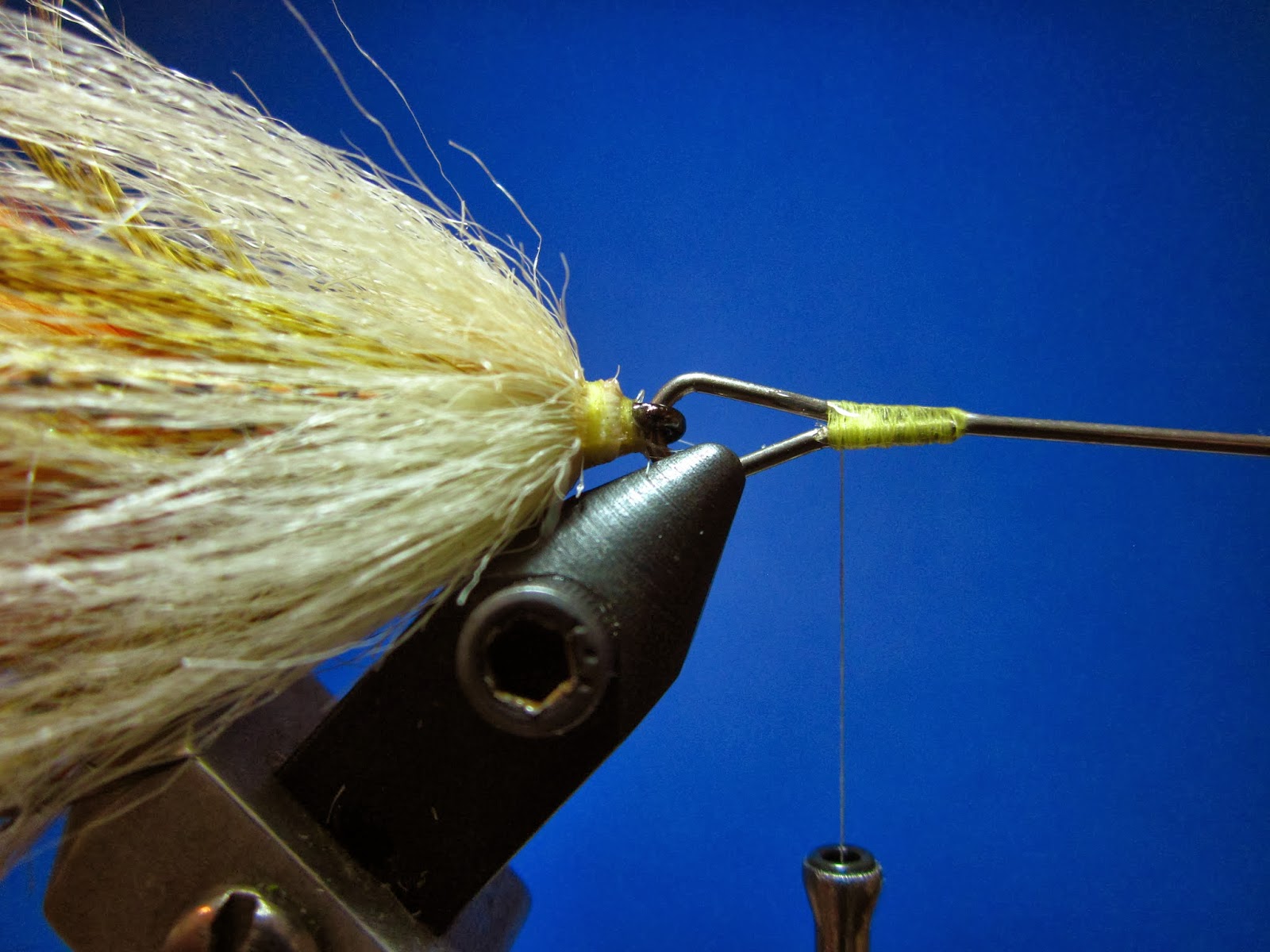
Insert the open end of the articulated shank through the hook eye, and secure with your thread.  Hit it with some cement.

Repeat the exact same steps on the shank, tying the same fly twice and leaving room for a head.

Center tie the sculpin wool on top and bottom, and fold back over the body to form the head.  Secure.

Glue on some peepers.  I went with the spares you get with the sculpin helmets here.  I was thinking "light and small" this entire fly, but you can certainly go bigger with the eyes.

Sip bourbon and admire.


Monday, September 30, 2013

Stop Sucking

Holding expertise does not always result in good teaching.  We've all had the express displeasure of being taught by less than stellar educators.  Not just in the classroom, but also in life, and for the purposes of this blog, in the field.

I've been told many times that I should've been or still should be a teacher.  The numbers are probably skewed simply because I know a lot of teachers and everything looks like a nail to a hammer, but it happens fairly often that somebody says, only half mockingly, "Dude, you shoulda been a teacher."  I disagree.

Even in the few areas in which I hold a modicum of expertise, my teaching style often leaves quite a bit to be desired.  Holding the knowledge is not the same as being able to express it in an articulate and useful manner.  I can easily recall more than one instance in which a session showing somebody how to tie a fly or make a roll cast devolved into near-silent charades, ever increasing in intensity until both of us were frustrated almost beyond caring.  Monkey see, monkey don't.  When I get flustered in a demo situation, my usually acceptable command of the language largely sublimates into the wind, and I'm reduced to mumbling idiocy.

Stop sucking, just do the shit like this! may have actually passed from internal mantra to verbal exhortation on occasion, though only with the buddies I know can take it while happily pointing out everything I stumble over.

Pro Tip: if you ever get the urge to teach your significant other to fly cast, just slam your head in the truck door a few times, and get it over with before you start.  The only time I've bickered more intensely was the time we tried to put plastic film up on the windows together in an old apartment.  That stuff that probably saves three nickles on the gas bill, but takes a year off your life due to the stress of putting it up together -- divorce lawyers should sell that stuff in bulk.

Zeke gives spinning a shot on my vice by lantern light
I will say that when it goes well, introducing somebody to a new skill can be very gratifying.  A while back I was in New York for a fishing vacation with some friends from an internet forum.  My buddy Zeke and I sat down at the vice for a lesson in spinning and stacking deer hair on the hook.  I managed to remain coherent and somewhat informative, he didn't get frustrated, and all went swimmingly.  As it ended up, a line of people formed at the table to take their turns at spinning hair, and I had to rush at the end to catch the evening bite out on the lake, grateful and humbled to have been looked to for a bit of instruction in something I am fairly practiced at.

It doesn't always go so smoothly.  I once found myself watching late night baseball with an inebriated Argentinian college student in a dorm room in Portland, Oregon.  You heard me.  We'd returned from a long night on the town with a group of students, and I was none too sober myself.  I don't recall now what happened to the rest of the group, but there we were, suddenly alone with the Mariners on the tube.  Saturday night rock stars.

While I'm no baseball expert, I am a patriot and fan with a comprehensive understanding of the rules.  Twenty-some years of fandom, however, did little in preparation to explain the simplest of baseball regulations to a wobbly South American struggling mightily to understand the game and remain upright on a bean bag chair.  Our little vignette here opens with a foul ball down the third base line.

"So, nothing happens if the man hits the ball outside those white lines?" slurred our foreign friend.

"Not exactly. It counts as a strike unless he already has two strikes.  If he has two strikes, then nothing happens.  Then it's basically out of bounds and a do-over."

The catcher then immediately fielded a foul pop to end the inning.  Slowly assuming the form and posture of a garden slug in the bean bag, "I thought you said nothing would happen?"

"Yeah... unless the defensive player catches it on the fly.  Then it's an out."

"What's 'on the fly'?"

"... so... you play soccer?"

Which goes to show there comes a point in our understanding of any subject or activity wherein we are able to pass over the details to take in the entire picture.  The little stuff becomes given that the big picture may play out.


Experts hold "conditionalized knowledge," meaning the knowledge they hold reflects context and situation, and they can retrieve it quickly without much additional effort in the corresponding instances.  Novices, by definition, cannot be so lucky.  They have to slog their way through seemingly important patterns and facets that may mean nothing in the big picture, but appear to hold the key to cracking the code at any moment.

We woodsmen look at the woods and see individual species.  How they might be useful to us or relate to the species we're chasing, be they feather, fur, or fungus.  We see systems and interconnectedness and where we'd build the lean-to if we had to spend an unplanned night.  The novice can't see that.

On the other hand, if I look at a spreadsheet full of numbers or a malfunctioning carburetor, my brains starts to go all soft and tallowy.  I hear the Benny Hill theme, and feel the need to go fishing.


No matter our level of teaching proficiency, it is our duty as outdoorsy folks of all stripes -- fishers and hunters, foragers and wanderers alike -- to teach.  To get outsiders involved in our favorite activities.  Not only to bring to them the same joy we feel out there, but to preserve our outdoor way of life.

I used to bristle at that thought.  My personal manner of getting outside involves a lot of getting away from, well... everybody.  That's not the right way or the wrong way, but often when I head out there, I'm hoping to pass my time without seeing another soul.


The thought of bringing others into it only to clutter up the joint once seemed so counter intuitive.  Why would anyone ever want to see more chuckleheads clogging up the trout stream?

The answer has become obvious with age and accumulated knowledge.  If we don't encourage others to partake, vast libraries of personal knowledge and experience will be lost forever.  Not only that, but when there's nobody left to practice our lifestyle it will be deemed outdated and inconsequential, ancillary at best.  It will wither on the vine.


The proliferation of technology as it pertains to our outdoor pursuits is a massive subject due an entire blog entry of its own here (and much more), but I will say that there are many examples of how it can be used for teaching and learning in the arena.  For me, YouTube plays a very large role.

I watch a lot of fly tying demos.  I have shelves full of fly tying books, and while they remain both useful and sometimes beautiful in their compositions, nothing beats seeing it happen right in front of your eyes, sometimes in high definition, with the ability to pause and rewind at will.

There are all sorts of fly tying teachers floating around out there in the YouTube ether.  They range in style, quality, and teaching ability across a wide spectrum -- from Brian Wise, whose videos of chunkalicious streamers are played back on fast forward to thumping music for those of us who have existing knowledge of the materials and techniques used, to Davie McPhail.  His very comfortable pace and euphonious brogue lend themselves to in-depth and relaxed, comprehensive instruction.  If you ever zoned out to Bob Ross and The Joy of Painting on PBS back in the day, that's the neighborhood Mr. McPhail inhabits to me in the fly tying world, and his videos are as mesmerizing as they are instructive.  A happy little pine tree lives right here...


This post is sort maundering out of control at this point, but I think what we're driving at here is that if you know how to do something, especially something outdoorsy where this blog lives, I think you should teach others how to do it.  Don't mind the fumblings and stumblings if your teaching style is as abrupt and stilted as mine sometimes is.  They'll be happy for the instruction.

Brian has been shooting woodcock since before I could dress myself.  When I think of proficiency in an outdoor activity, I often think of him.  The way he powders a bird, then thumbs another shell into that ultralight pump gun as an afterthought.  I'm grateful for his years of instruction, and happy to report that the young buck here can now often hit the bird before he does when we swing on the same one.  Sucks getting old, I'm told.

Of course, all the experience in the world, mountains of teaching and learning, can do little when the birds simply aren't there.  Sometimes you just have to follow the old guy's lead when he says...

... Piss on it, dude.  Let's go get a burger.


Thursday, September 19, 2013

Zoning Out

I played golf once in college, and that was about the third time I'd ever been on a course other than to float tiny "boats" down streams and generally stomp around in winter.  I don't remember the circumstances that lead to me suddenly finding myself, squinting slightly dazed and out of place, on a driving range with my buddies Ace and Dean, but there I was giving it a shot.

I had an excellent teacher in the Aceman.  He was a single-digit handicapper at the time with the long, flowing swing employed successfully only by those of athletic grace unknown to most of us.  (An athletic prowess, by the way, that also allowed him to almost casually throw at extremely snappy velocities.  I can easily recall that distinctive rocketing hssssss of an Ace-thrown baseball -- the hiss you only hear when a ball has been fired from a serious arm cannon.  And the startling mitt POP! that would make people stop and look while we threw the ball around in the green space now occupied by the Kohl Center.)

There we stood on the recently rain-soaked range with a bucket of balls and a teacher whose very moniker had been earned through achieving a hole in one not once, but twice.  Ace is a good friend, so with undying patience he instructed me from the ground up.  Tips and pointers I don't remember about hips and elbows.  How this should feel and that should look.  Keep my hands here, pause there, and remember to breath.

I was headed for the PGA, and I hadn't even hit a ball yet.  After absorbing all the instruction I could hold, I stepped up to the tee for my first colossal hack, and unceremoniously buried the face of the club deep in the mud about a foot behind the ball.  A ball that remained frustratingly inert on the tee, completely unmoved by my ungainly thrashing.  It was then that I further considered dedicating my free time to becoming a mediocre fly fisherman rather than an awful golfer.

Somewhere in the midst of our later 9-hole round a wholly unexpected thing happened.  I'd hit a decent drive (one that didn't fly off on some oblique trajectory, actually landed in the fairway to the amazement of all),  and under Ace's instruction, I lined up my iron shot.  In that mystifying and elusive moment that happens only so rarely, I swung easily and made a fine shot.  More importantly here, I felt it almost immediately on the strike.

It landed pin high, on the left edge where he had told me to aim, and followed the natural slope of the green down so near the cup even I could make the putt.  I walked up, read the break correctly, and put it in the hole.  The remainder of my round was an ongoing and unmitigated catastrophe the likes of which they should've written brooding Norse sagas about, but for the briefest of instances, I'd known what it felt like to be "in the zone" on a golf course.

I don't think we really know what "the zone" is.  The fact that it may be different for everyone or may come in varying degrees of intensity for the same person make defining it even more difficult.  For me it involves a full immersion in the activity at hand.  Complete focus and control in that time span also play roles.  And the infamous time distortion people mention.  It felt like everything was happening in slow motion -- we hear and say that a lot when we talk about the zone.


It's a rare and beautiful thing to find oneself in the zone.  Even rarer to suddenly blip into existence there right out of the gate.

I took a walk in the woods behind the house this past weekend, armed with my much-loved bolt action .22 and thoughts of fried squirrel.  Hunting seasons had just opened that morning in Wisconsin, and I was primed and pumped to gather some protein.  A shotgun is often a more logical choice for early season squirrels, often obscured from the shooter with all the green still up, but my first tree rat hunt of the year will be with that nimble little Savage rimfire until one of us is in the ground.

I grew up shooting that peep sight, and had a bit of a tough time adjusting to scoped rifles when it became clear I was going to get more shooting opportunities using them in the low light conditions when bucks often appear.  I got comfortable enough eventually, but there still exists a smidge of hesitation and adjustment when I put my eye behind a scope that isn't there behind the Lyman.

It's to the point now, using that .22 with the peep on shots that test the limits of both gun and marksman, that it becomes nothing more than a matter of feel.  Meat conserving head shots are paramount to me on small game such as squirrels.  When Mr. Fluffy Tail appears before me at such a trying range that he is almost completely obscured by the front sight post and I lean the barrel against a tree for support, I hold on the center of his body, and give the slightest nudge with my cheek or left thumb as I take out the last bit of trigger creep. (I actually clench my teeth when I need to push left, making that little knot pop out on the corner of my jaw, and that does the trick).  I settle there, and with the lightest, almost inadvertent addition of pressure to the trigger, when I'm in the zone, the lead is well on past my dinner's far ear before he even begins his tumble to the forest floor.

I gave up, and contented myself with stealing his dinner.
It doesn't always happen that way, but it did twice on Saturday morning.  A welcome and surprisingly abrupt return to the sweet spot in a breeze barely hinting at the cold to come.  Monday morning I missed a much closer squirrel twice with a scatter gun.  Though, as if to present a convenient excuse for me which I'll gladly employ here, he was bounding along up in the thick green tops.


Comfort, and even a little time in the zone, did eventually come with the scoped rifles.  I remember the first buck I shot when I used to hunt over by the rifle range years ago.

I had a tree stand parked on a thickly poppled knob overlooking a beaver pond and the game trail that encircled its perimeter, supported by an aspen roughly the diameter and tensile strength of overcooked rigatoni.  It was a nice spot, but there was plenty of pucker factor in that little tree on windy days.

I'd grown comfortable enough with the scope by that point, but by some happenstance unknown to me, I found myself running through the process of the shot in my mind all through the season that year.  Even on the drive up, I concentrated obsessively on sight picture, trigger pull, and follow through.  While hunting, I ran the imagery through my mind on a near-constant loop like an athlete would do before a contest, as a way to remain alert on the stand.

Quit making me laugh, ya bastards. This is serious.
When that massive northwoods buck (OK, it was just a little forky) stepped into view, I was prepared.  For the first time in my brief career as wielder of a scoped centerfire, there was no need for pause or adjustment.  It was about the only time I've ever set the crosshairs immediately and precisely where I wanted them on an animal.  One of the very few times I pulled smoothly and saw the impact happen through the scope, saw the insides explosively become the outsides on the other side of his rib cage as clearly as if it had happened five feet away.  I guess sometimes you can pick the locks, and force your way into the zone.  I don't know why I don't more often.  I miss often enough that I certainly should.


That sweet spot of perfect execution is not limited to shooting, of course.  I most often encounter it at the fly vice and sometimes in the kitchen or sitting here spewing forth these tales of outdoor triumph and failure.

The doing of repetitious small tasks often leads me there.  Anything from spinning repeated gobs of deer hair on a hook to peeling a pile of spuds, the activity in question doesn't matter.  If I'm in the right mindset I'll make it a game, imagining myself in a contest to become the fastest and cleanest tater peeler this side of the ol' Mississip.  Soon I'm on autopilot, hands functioning with almost no thought given to their actions.

We used to talk quite a bit about that state of "rigorous autopilot" in drum & bugle corps (insert collective moan from the DSO fellas, I know.  Bear with me, gentlemen).  At that activity's highest levels, the search for perfection leads up a path that eventually comes to extremely small degrees of differentiation at the apex of a huge scale.  Minutiae and exacting detail rule your every performing thought at those tiny spans of separation.  Fractions of pitches and inches and seconds.   After hundreds of hours of rehearsal on a single piece of music and movement, so much information concerning technique and execution has been wedged into the soul of the player that he or she cannnot hope to perform at an acceptable level outside that near-mystical level of precision autopilot.  You just line up and twelve minutes later, panting hard and dripping sweat, they're screaming in the stands.  Deep in the zone.

The place I often find the autopilot zone most fleeting and frustratingly elusory also happens to be one of my favorite pastimes -- fly fishing.  More specifically, the glorious and terrible art of casting.  Much like the golf swing, fly casting is all about rhythm, timing, and feel.  And much like the golf swing, you can learn the basics in a short time, then spend decades working out the kinks to perfect it.  It's all long flowing loops and the poetry of physics in motion until it isn't.  Then it's tripping on line, strained epithets, and ugly coiled heaps on the water.


I have dipped a toe in the cryptic pool of flycasting zone on occasion, and a particular cast and fish stands out in the recalling of rare moments basking in that gentle glow.

A couple years ago I was invited to take part in a shakedown smallmouth trip on a Michigan river with my buddy Flockshot and his guide friend Aaron.  Even though we caught fish numbering somewhere on the north side of sixty that day, Flock may remember this particular fish when he reads this.  I'm not a whooping and hollering Fish On! type when I latch in to a big one.  Instead I usually go silent in concentration, but at the moment of this particular bite in the zone, I startled myself and everyone else by sharply bellowing, "Holy shit!" loud enough to shatter the gentle sussurations of a pleasant trip down the river.

My float had begun spectacularly far outside the zone.  Casting with a guide rod, on an unfamiliar river, standing at the bow of a raft I'd never been in, I was a towering beacon of suck.  Flailing like a crack monkey.  I couldn't see the solar system containing the zone with the Hubble Space Telescope.  With time and a couple smallish fish, I slowly improved.  Eventually, I got my wits about me and my act together, and began to fish like a moderately competent human being.

It was an odd day on the river, for me at least, in that we started with dink smallies, and the fish got progressively larger as we neared the end.  Maybe Aaron used his double secret guide mojo or the power of the beard to home in on the proper fly selection and boat positioning as the day played out.  Or maybe the fatties were too lazy to swim upstream to our launch.  I'm not sure.

Somewhere around the midpoint of the float, I found myself approaching an event horizon of imminent zonage.  Still in the bow as a guest, my cast had un-bungled itself into something resembling an effective fly presenting tool.  I spied a perfect lie -- an underwater log, barely visible from behind polarized amber shades, jutting into the current with that slick of pillow water behind it that denotes a washed out hole.  Overhanging brush provided both shade and cover for the hole, and a formidable defense against probing flies.

You forget to grin like an idiot when stumbling down out of the zone. 
Everything slowed.  I took a breath, a double-haul false cast, and laid a long, low cast perfectly just upstream of the log.  A quick mend gave the streamer a moment's pause, and it disappeared into the deep.  The instant my offering vanished from clear view I witnessed that slightly eerie signature apparition, that thing we're all chasing out there waving sticks around -- the torpedo flash and shadow of Darwin's own predator crushing the life out of a fly.

It was a great fish, though not my biggest of the day.  Probably not even the biggest that hour.  But it remains clear to mind (and heart) among countless other catches before and since because it happened when all things came together, when focus and motivation collided with loss of self consciousness at the zenith of control.

It happened in the zone.    

Monday, March 25, 2013

A Diminutive King and Fallen Castle

This blog entry has been written in concert with a tying tutorial I did for my bluegill fly pattern, the Disco Cricket, over on The Fiberglass Manifesto, and author Cameron Mortenson's "Year of the Bluegill" initiative. Please head over there and check it out.  You fly fishers in particular should really enjoy the entire site.


I know a lot of us began our fishing careers chasing the humble little bluegill.  We stood there on shore, some of us with a cane pole and a bobber, and flicked squiggly globs of leaf worms to lily pads in the shallows, in hopes of hauling in a fish or two.  We didn't notice the differences between the varied species of these diminutive scrappers, nor were we aware of their many names -- long ear, shellcracker, pumpkin seed, red ear -- they were all bluegills to us kids, probably bream ("brim", as they say) to our southern counterparts.  Honestly, I still have trouble keeping all the different, brightly painted little guys straight sometimes.

Many of us learned to fish on bluegills because they are often so willing to bite.  As any muddy little kid with a sunburn and a Zebco can tell you, they will sometimes even bite on a plain gold hook when the bait can runs dry.  That makes the sunfishes royalty of the novice youth fishing world.

They're also very accessible.  Almost every splotch of blue on the map has at least a handful of sunnies patrolling the shoreline, darting into the weeds when you walk up to the bank.  Nothing is better for a kid learning to fish than actually being able to see what he's going after.  The fishing itself can be a very visual affair as well.  You can see the curious little ones swim right up, and take a nip at your bobber.  I know for myself, I wasted many a childhood afternoon trying to figure out how to catch those guys, matching wits with a three inch fish and losing.

When you do finally get a couple years of bluegill fishing under your belt, you know even more what to look for.  And what to listen for.  When the day finally comes that you spot those pie pan spawning beds laid out like honeycomb on lake bed, when you hear that little spluck! noise they make sucking in bugs from the surface, you know you're in for one of those days we fishy folk dream of.

The final part of the equation has to be the tremendous fight these buggers put up.  A bluegill flat-out pulls his little butt off.  They dart and dive, and the bigger ones do that fun spinny thing, like a maple seed falling up in reverse.  All great fun to cut your teeth on.


Then comes the time in our fishing lives when some of us are overtaken with the need to find and fight the big bluegills.  This is no longer a matter of simply flopping a bait into the city park pond, and waiting for the fish to come play.  The bruisers aren't so easily fooled -- as the saying goes, that's how they got to be bruisers, after all.  They hang out in deeper water than their slimmer brethren, they're often much more finicky about what they'll eat, and they'll yank on your 4lb. mono until they've buried your hook in the weeds, and you're left with nothing but a glob of muddy salad to show for it.  We're not in the minors anymore, this is the show, and it's wonderfully fun.

Not incidentally, bluegills are my favorite freshwater fish at the table.  Always have been.  I know the walleye and perch people will be up in arms of over this, not to mention you brookie guys and those weird, scary catfish dudes, but that's the way it is.  Given my druthers, it'd be a beer batter bluegill fry and sweet corn, with a couple thick slabs of tomato, still warm from the garden sun.  Pass me a PBR.

That's what you drink at a bluegill fry, by the way.  Go ahead and check, it's in the Constitution.  Bluegills are not craft beer fish.

For the novice fly fisher, just as the young gear fisher, bluegills are often there to help learn the sport.  Newbie fly geeks are often nearly as helpless as any kid with his first cane pole, so it works out that the quarry would be the same.  Personally, when I picked up my first dime store fly rod, and began to cast to the dink sunnies in the shallows, I was swept back to the age of dunking worms with my brother, when we'd spent more time throwing rocks than trying to catch fish.

And again, the progression with the fly rod remains the same as it was with the cane poles and spinning rods.  Obsession grows.  Sooner or later you find yourself casting past dark out with the ticks and mosquitoes, seeking advice and articles, dreaming of truly giant bulls on a fly rod.  These are not the mythic salmon of Scotland or high mountain cutties, but bluegills, through some combination of their tenacity and willingness to bite, can become downright addictive.

I don't think we need to employ Cold War era spy craft, using double secret codes and marking park benches with chalk at dusk (as is the standard internet tradecraft of covert fly fishing operatives everywhere) when mentioning that Lake Onalaska, over on the western edge of Wisconsin, is home to some of the best sunfishing you'll find anywhere.

They've pretty much put the word out.
The lake is formed by a dam on the Mississippi River.  There are miles and miles of braided water through a stand of islands at the north end of the lake where the smallmouth bass and pike fishing can be excellent.  We've spent many days up there, and occasionally nearly had to spend the night there too, after losing our way in the dozens of  near-identical looking channels.  For some reason, I was always the one who had to get out, and pull the boat over a sand bar while Brian yelled threateningly from the back of the boat, "If I have to put this beer down..."

The allure of "the chutes" as they are known locally, all those back channels and wandering paths between spits of river mud and sandy little islets, is great, but the real action happens down in the bluegill water.  Spring and fall especially, when the bite is on, you won't have to ask where, just follow the armada.  Massive sparkle fleck bass tournament rigs, fairly bristling with every fishing electronic known to exist, pull up beside plastic, roto-molded jon boats in the shallows, and everybody catches bluegills.

Lots of fish. And big ones.  Consistently over time, the biggest 'gills I've ever seen in person.  I've heard every theory out there concerning how and why this place is a sunfish factory (I like the one about the river current washing scuds and other yummies down to the pig bluegills lying in wait), but I don't think anyone really knows how exactly it works.  The important thing here, as a far as the angler is concerned, is that when the time is right, you can fight the fattest 'gills you've ever seen until the basket is full, and get up to do it again the next day.  I have, and I can personally guarantee you that none of those fish have gone to waste.


Brian inherited the trailer from Marty years before I started coming to Onalaska for bluegill bonanza weekends.  "Ol' Number 14" had been laid to rest some decades before, deemed unsafe for human habitation by any sane person, on the top of a small wooded rise in a campground right on the water, lending great views of the lake and fall sunsets from the picnic table parked out front.

Getting unpacked for another weekend at the very swank No. 14
Lest you get the wrong impression, all was not Midas gold at the trailer.  The first time I was invited, the temps dipped well below freezing for our ice fishing weekend.  When we arrived after dark, there was no power in the campground and the furnace would not run.  Within minutes, Brian spilled the Coleman lantern he was attempting to light, sending a river of flaming white gas down the counter top.  The trailer didn't burn down, but only because it was too rotten to ignite.  That night my pillow froze into a point on one end, conforming to the inside corner of the trailer as I dozed warmly with my brandy sodden dreams on the floor, stocking cap pulled down tight.  I was immediately in love with the place.

Brian and Dad, the power back on
No matter how many times her roof was resealed with blackjack, scrap sheeting, and prayers; rain always managed to run in, especially through the roof vent over the dubiously designated "living area."  Which was convenient, actually, because that's where the hole in the floor was for it to drain out.

She did have a working cook top and tiny oven, the latter of which hovered at random temperatures somewhere between glumly cadaverous and positively solar.  We used it to alternately freeze dry and vulcanize meals brought from home.  Bluegills were fried outside on the reliable old green Coleman stove, and we quickly learned where the local pizza place was.

Her greatest feature, though, was most shocking.  Literally.  After a long, soaking rain or in spring when the frost was coming out and the ground was wet, all of her metal surfaces would become electrified to the touch.  I'm not an electrician, but I remain fairly positive that wasn't right.

Brian and I would get quietly giggly on Blatz and Korbel back then, and invite fellow campers from around the grounds over for a drink.  The entire time just dying inside, waiting for them to unknowingly brush up against a wall or range hood and be jolted into a cussing streak. Yes it was mean and juvenile.  It was also some of the greatest fun I've ever had.  Closest I've ever come to peeing myself from laughter.


Buddy quickly learned that track would sting his little paws. Built in puppy barrier.
The allure of living in constant fear of being zapped, drenched, frozen or broiled alive on those summer smallie trips aside, the real reason for being there was the bluegill fishing.  At the right time of year, a limit of heavy 'gills could be acquired in plenty of time to spend the rest of the morning in junk yards looking for trailer repair parts.

Big, thick gills, too heavy for a heron, apparently.
It was not uncommon to catch them two at a time...
... or four...
... or simply have one greedy fish inhale every bait you could throw.


Ol' No. 14, beauty that she was, is gone now, trundled off to the big campground in the sky where the fish are even bigger and nobody gets electrocuted by leaning against a window air conditioner.  She brought us together, became our base camp for a lot of wonderful outdoor pursuits.  Not the least of which was embodied by the small but mighty, pugnacious king of the panfish in my mind, the ever-ready bluegill.


Sunday, February 17, 2013

Into the Deep

Earlier this week I was invited to attend a lecture concerning the stewardship and preservation of local geological features with an eye toward public history.  It had been quite a while since I sat in a classroom and watched a PowerPoint, but I was interested in the subject matter and happy to have been asked to attend.  The presenter, a family friend, was deeply knowledgeable and committed to his subject matter, and I came away from the lecture not only with a deeper understanding of my geologic surroundings, but thoughts of the web of connections we outdoorsmen and women can take part in when we see fit.

While none of us, professional guide to occasional weekend warrior, can truly take part in the entire twirling kaleidoscope of interconnectedness that surrounds us while we pass our free hours afield, some of us do try.  Others do not, and that's fine too.  To each their own and all that.

Take, for example, "Don the Deer Hunter."  Don is a guy I just now made up, but he seems like a pretty amiable chap.  He's a good dad and husband.  He hoards his vacation days to hang out in a tree stand with a bow or rifle, and hunt big bucks.  Beginning sometime around Memorial Day each year, he sits entranced by deer hunting articles and TV shows.  The post counts of Rackstabber169 (Don's internet alter-ego) soar on BigRacks.com and CervidAssassin.org, his chosen whitetail internet forums.  His truck is a rolling billboard for makers of specialized hunting gear and equipment.

He hunts quite a few days in the fall, a dedicated man this Don, and does very well for himself.  The walls of his den are adorned with many trophies, testaments to the majesty of nature in antler form, and to Don's commitment to his chosen passion.  He scouts year-round and dreams of the rut at night.  Don is a highly skilled specialist, and quite content being just that.

Don, by the way, cannot recognize a single constellation outside the Big Dipper or any dangerous or edible plants. He starts his fires with lighter fluid, gas, or not at all.  His knots are of the Swiss navy variety.  He has some experience identifying the flora a whitetail browses on throughout the year, but only because that is vital information to his specialization.  He has no idea how the lake he can see in the distance from his favorite tree stand got there, how old it is, or what's in it.  These questions may not even have occurred to ol' Donny, face painted and bow hanging on the $30 "proprietary" (the maker painted it camo) extreme, lightweight space-age screw hook in the tree next to him.

Even though he makes a dumb joke every time he hears the term "climax forest," and has never heard of forest succession as a concept, I hold no ill will toward our good fellow, Don.  He is, without a doubt, a more accomplished whitetail hunter than I am or will ever be.  His entire life's purpose outside of work and family is to put a drop-tine on the wall.  He is a specialist.  A deer hunter, not a woodsman.  That is a point of distinction, not a point of contention or derision.  There is a difference, and that is all.  Spatting over how we choose to spend our time in the woods is ridiculous and uncalled for.

I know a few of these Dons in the deer hunting world, and a few more in the realm of fly fishing.  They are completely comfortable narrowing their focus down to one species or technique or body of water.  In the testosterone-fueled check this shit out! world of today's internet fly fishing, to be recognized as one of the the tribe, one has to specialize.  To fish 300 days a year behind designer shades, throw perfectly tight loops out to 100 feet at all times, and have designed at least three fly patterns with names not fit for repetition in mixed company.  Or have a pink reel and cleavage erupting from an implausibly strained Columbia fishing shirt.  And sadly, that seems to be the entire point a lot of the time -- to get noticed.

I will never be recognized at the fore of most tribes because I'm not an extreme specialist.  I am decidedly not an expert in any single outdoor endeavor other than falling asleep in blinds.  Whether through lack of commitment or the simple urge to learn the next thing (maybe they're the same), I have become a happy generalist.  I would like to sit down with Donny, however, and pick his brain on the subject of whitetail hunting for a while.

Perhaps it's because I am not a joiner by nature.  If you've been reading here long enough, you know by now that I take joy from harvesting my protein well, cooking it with some modicum of respect and care, and sharing it with family and friends when I can.  But all the organic locavore, glossy farm-to-table onanism going on lately makes my skin crawl sometimes.  Not that the terms or concepts bug me.  Quite the opposite happens to be true.  I'd simply like to shoot a couple rabbits and make my gnocchi, or pickle a passel of ramps for my gimlets, without having to attend a club meeting to pat each other's backs over it afterward, thank you.

To my great dismay, I do occasionally feel a petty, initial tinge of jealousy in the face of those we deem to be expert-specialists in the fields I wander through.  The lauded oracles of fly fishing, foraging, and convincing animals to tip over for the pan.  The rock stars.  It's completely ridiculous and unfounded.  When I first came upon MeatEater and Hunter Angler Gardener Cook, to name but a couple, my initial, admittedly shallow and embarrassing reaction to them was an over-critical, sotto voce muttering... who are these knuckleheads doing what I love?  Only better.  Of course, almost immediately I began to enjoy and appreciate their blogs and books, my knee-jerk (emphasis on jerk) immaturity not withstanding.  Their efforts, in part, have not only improved my foraging and hunting, but have also paved the way for hundreds, maybe thousands, of outdoor blogger-types like yours truly.  I will never again be without reading material as long as my phone is charged.

Not that I'm writing in a vacuum here.  Truthfully, I get a charge out of watching my readership here grow, there's no denying that.  And I understand that products have to be sold, money has to be made, and that there apparently exists a glut of Dubstep music out there, written entirely for the the purpose of being lain under fly fishing videos on YouTube.  I'm just asking: What happened to going fishing without a GoPro duct taped to your every appendage, then having a beer by headlamp on the tailgate and heading home?


While still a dirt-covered youngster, I was exposed to, and the recipient of great gifts from, a comprehensive outdoor education program in elementary school.  Dad and Brian, and most of my aunts and uncles were also lead through this science curriculum, sometimes, in one of those quaint circle-of-life small town circumstances, by the same teachers I had.  In "OE," as we called it, every science class of a 5th-grader's school year was dedicated to learning about the outside world.  We learned our birds, fish, wild flowers, rocks, and mammals.  We gave stuttering presentations on environmental concerns and mumbled tours of the school's arboretum with our new-found knowledge to parents, family, and local dignitaries.  But more than that, we were introduced to the bigger concepts.  Evolution and adaptations, patterns, the cycles of water and carbon, the ice age that shaped our surroundings... even isostatic rebound, come to think of it, though they didn't call it that to us back then.  All that, combined with a bushcraft enthusiast father, led to my tremendous head start in not only knowledge of flora and fauna, but thinking of the entire works as one big system, and I am forever grateful for that.

"Practice while you're warm and dry, so you can do it when you ain't" ~Dad

Years later, I was introduced to the concept of "deep mapping" in a eureka moment when I stumbled across a copy of William Least Heat-Moon's PrairyErth at the Frugal Muse bookstore in Madison.  His massively immersive tome is a deep look into the geological, natural, and human history of a single county in Kansas.  From the folklore to the history and formation of the soil itself, it's all in there.  The author spent six years obsessively familiarizing himself with every nook and cranny of the place, and I'm not the only reader to have deemed his work a masterpiece.

This concept of deep mapping -- the act of collecting multiple qualitative and quantitative data as it relates to a place in order to create a near-complete spatial picture and narrative -- struck a heavy chord with me as it relates to my outdoor pursuits.  That a person could become immersed in the seemingly unconnected minutia of a place to build a more complete picture of the whole... when applied to tromping around outside with a gun or gunny sack, that thought still gets me going.

Back to what brought us here, that geology presentation earlier this week.

The unique geology of Wisconsin alone is a subject worthy of study and admiration, even to a simple layman carrying a pheasant gun and a bruised-up apple in his vest.  We have a treasure trove of accessible and easily researched areas and formations here, and just because we choose to spend our time chasing turkeys and mushrooms in and on them, that does not preclude some of us from wanting to learn more about them, geologists though we'll never be.  The Kettle Moraine, smushed up between two lobes of an ancient glacier that bears our state's name, on which I have passed nearly my entire life; the far-reaching Niagara Escarpment, the Baraboo Hills and Devil's Lake, the verdant Driftless area with untold miles of burbling trout water, the staggeringly beautiful Dells -- all of them appeal to me, not only as they relate to my weekends shooting behind woodcock and jumping the hookset on topwater bass, but as individual parts of the larger whole.

Top o' the world, Ma!  On 1.7 billion-year-old Baraboo Quartzite at Devil's Lake. Photo cred: Spanky


I meet these things under my boots and as vistas before me.  They've helped to mold who I am because I exist in the biome they support.  And that's just the flashy geology I, a member of the lay general public, am acquainted with through books read in anticipation of hunting, foraging and fishing trips.

At the opposite end of the same great spectrum from our single-minded specialist buddy Don, I am a generalist outdoorsman.  Duck misser and faller-downer.  Occasional practitioner of coercing fire from rocks and sticks and getting lost just to get un-lost.  And a deep mapper of my small part of the world.

Here's to us, we curious life-long students of the outdoors.  We experts of nothing, we who fish and hunt, navigate with map and compass, forage and paddle.  We who start matchless fires in the snow for practice, who stop to read historical markers on the shoulder of the road and consult the tattered copy of Roadside Geology of Wisconsin stashed behind the truck seat; all with a pittance of expertise and an abundance of awe and enthusiasm.

Related Posts Plugin for WordPress, Blogger...