Showing posts with label smallmouth bass. Show all posts

Thursday, October 10, 2013

Tracer Round Tutorial

I was struck by the muse in the bottle last night, sipping bourbon and staring at the vice, when the color of my Buffalo Trace in the glass inspired a new pattern.  It's been a while since I did a fly tying tutorial, and I've never done one here on A Tenderloin, so here we go... Introducing, The Tracer Round.

"New pattern" being a relative term, of course, and a bit of a stretch in most cases -- including this one.  Almost all flies in the modern era are revamped iterations of previous patterns.  With very few exceptions (I'm looking at you and your Game Changer, Mr. Chocklett), most of us tie directly on the shoulders of, and in concert with, our contemporaries.

I do bristle a bit when one among us throws a different set of legs (head, wings, etc.) on a well-loved pattern, and calls it their own.  But barring the occasional leap forward in creativity at the vise, that's how these things most often evolve.  If you can't see the Wooly Buggers in a Sex Dungeon, you need your eyes checked.

Try that as a pick-up line at the bar sometime.

So we watch what the other guys are tying, and add our own twist to the mix.  More presciently, some of the more observant and intuitive among us attempt the fill a void in our repertoire or more completely appease the "needs" of certain fishing conditions with a certain pattern.  The latter is partly where I was coming from with the Tracer Round, alcohol-fueled inspiration aside.

If you've read here much at all, you know I'm a proponent of the big, meaty articulated streamers.  They're fun to tie, fun to chuck, and they work.  They've also left a hole in the spectrum of the flies I like to tie and fish.  In my boxes you can -- concerning size and profile -- reach for either a #8 bugger or the like on the small end... or ginormous, honking articulated streamers of all manner on the big end.  And there ain't much in between.

Hopefully a smaller and lighter articulated fly like the Tracer Round, downright dainty as it is compared to its steroidal streamer brethren, will help fill that void.  To my mind, it can, um... trace (sorry) its lineage to a bunch of Hog Snare, some Voodoo Squatch, with a little Sex Dungeon and Peanut Envy thrown in.  Not to mention a good dose of Kentucky firewater.


Enough with the yapping.  Nobody cares.  Let's tie.

The Hardware:
Gamakatsu B10s #2
35mm Fish Skull shank
Uni 8/0 - Light Cahill

The Software:
Marabou - cream, tan, burnt orange
Fire Fly - gold
Krystal Flash - root beer
Mallard Flank - "wood duck" gold
Dubbing - Awesome Possum, light yellow
Mini Speckled Centipede Legs (Orvis) -  orange, tan
Craft Fur -  cream, tan
Sculpin Wool - tan
Fish Skull Living Eyes - Earth

Tie in a sparse cream marabou tail the length of the shank.  I'm pulling off the "waste" pieces near the base of the quill here, so as to not use an entire plume for something that's gonna be pretty buried.  Just need a little color here.

Tie in a tan marabou plume by the tip, and make 2 wraps forward.  Like a wet fly hackle.  Secure.

Add a few strands each of gold Fire Fly and root beer Krystal Flash.  Trim just longer than the tail.

Tie in a burnt orange marabou feather by the tip, and make 2 wraps forward.  Like a wet fly hackle.  Secure.

Tie in the gold mallard flank by the tip, and dub forward about half the shank length.

Palmer the mallard flank forward to the end of the dubbing and secure.  Repeat with another, larger mallard flank and round of dubbing.  Palmer forward to within about a hook-eye distance of the eye.

Center tie one each of the orange and tan centipede legs, folding over to secure so you end up with 4 legs per side.  Trim just shorter than the tail.

Reverse tie 2 clumps of craft fur.  Cream on the bottom, tan on top.

Fold back the craft fur (the body of a ball point pen works great here), and secure over the body of the fly.

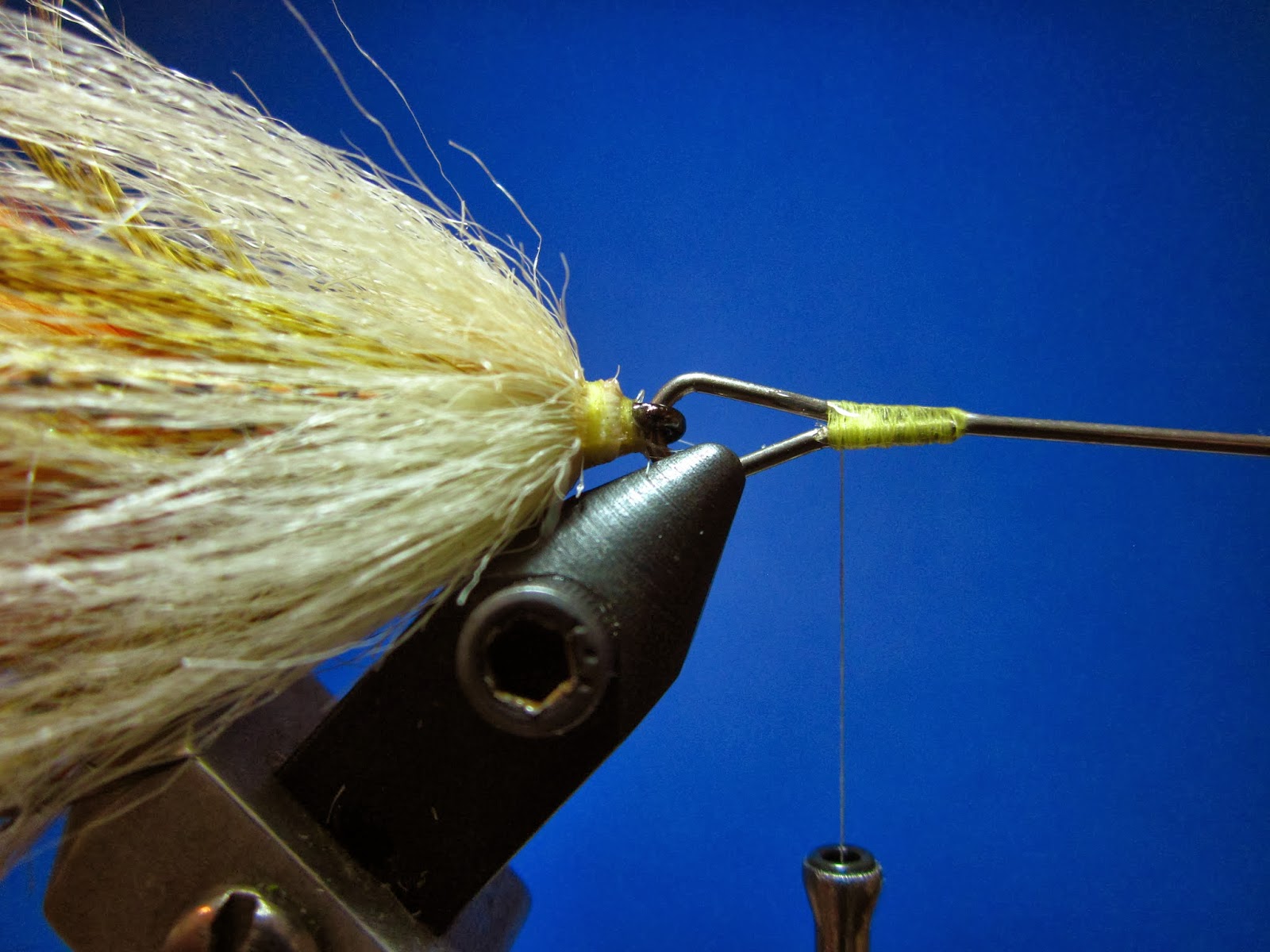
Insert the open end of the articulated shank through the hook eye, and secure with your thread.  Hit it with some cement.

Repeat the exact same steps on the shank, tying the same fly twice and leaving room for a head.

Center tie the sculpin wool on top and bottom, and fold back over the body to form the head.  Secure.

Glue on some peepers.  I went with the spares you get with the sculpin helmets here.  I was thinking "light and small" this entire fly, but you can certainly go bigger with the eyes.

Sip bourbon and admire.


Thursday, September 19, 2013

Zoning Out

I played golf once in college, and that was about the third time I'd ever been on a course other than to float tiny "boats" down streams and generally stomp around in winter.  I don't remember the circumstances that lead to me suddenly finding myself, squinting slightly dazed and out of place, on a driving range with my buddies Ace and Dean, but there I was giving it a shot.

I had an excellent teacher in the Aceman.  He was a single-digit handicapper at the time with the long, flowing swing employed successfully only by those of athletic grace unknown to most of us.  (An athletic prowess, by the way, that also allowed him to almost casually throw at extremely snappy velocities.  I can easily recall that distinctive rocketing hssssss of an Ace-thrown baseball -- the hiss you only hear when a ball has been fired from a serious arm cannon.  And the startling mitt POP! that would make people stop and look while we threw the ball around in the green space now occupied by the Kohl Center.)

There we stood on the recently rain-soaked range with a bucket of balls and a teacher whose very moniker had been earned through achieving a hole in one not once, but twice.  Ace is a good friend, so with undying patience he instructed me from the ground up.  Tips and pointers I don't remember about hips and elbows.  How this should feel and that should look.  Keep my hands here, pause there, and remember to breath.

I was headed for the PGA, and I hadn't even hit a ball yet.  After absorbing all the instruction I could hold, I stepped up to the tee for my first colossal hack, and unceremoniously buried the face of the club deep in the mud about a foot behind the ball.  A ball that remained frustratingly inert on the tee, completely unmoved by my ungainly thrashing.  It was then that I further considered dedicating my free time to becoming a mediocre fly fisherman rather than an awful golfer.

Somewhere in the midst of our later 9-hole round a wholly unexpected thing happened.  I'd hit a decent drive (one that didn't fly off on some oblique trajectory, actually landed in the fairway to the amazement of all),  and under Ace's instruction, I lined up my iron shot.  In that mystifying and elusive moment that happens only so rarely, I swung easily and made a fine shot.  More importantly here, I felt it almost immediately on the strike.

It landed pin high, on the left edge where he had told me to aim, and followed the natural slope of the green down so near the cup even I could make the putt.  I walked up, read the break correctly, and put it in the hole.  The remainder of my round was an ongoing and unmitigated catastrophe the likes of which they should've written brooding Norse sagas about, but for the briefest of instances, I'd known what it felt like to be "in the zone" on a golf course.

I don't think we really know what "the zone" is.  The fact that it may be different for everyone or may come in varying degrees of intensity for the same person make defining it even more difficult.  For me it involves a full immersion in the activity at hand.  Complete focus and control in that time span also play roles.  And the infamous time distortion people mention.  It felt like everything was happening in slow motion -- we hear and say that a lot when we talk about the zone.


It's a rare and beautiful thing to find oneself in the zone.  Even rarer to suddenly blip into existence there right out of the gate.

I took a walk in the woods behind the house this past weekend, armed with my much-loved bolt action .22 and thoughts of fried squirrel.  Hunting seasons had just opened that morning in Wisconsin, and I was primed and pumped to gather some protein.  A shotgun is often a more logical choice for early season squirrels, often obscured from the shooter with all the green still up, but my first tree rat hunt of the year will be with that nimble little Savage rimfire until one of us is in the ground.

I grew up shooting that peep sight, and had a bit of a tough time adjusting to scoped rifles when it became clear I was going to get more shooting opportunities using them in the low light conditions when bucks often appear.  I got comfortable enough eventually, but there still exists a smidge of hesitation and adjustment when I put my eye behind a scope that isn't there behind the Lyman.

It's to the point now, using that .22 with the peep on shots that test the limits of both gun and marksman, that it becomes nothing more than a matter of feel.  Meat conserving head shots are paramount to me on small game such as squirrels.  When Mr. Fluffy Tail appears before me at such a trying range that he is almost completely obscured by the front sight post and I lean the barrel against a tree for support, I hold on the center of his body, and give the slightest nudge with my cheek or left thumb as I take out the last bit of trigger creep. (I actually clench my teeth when I need to push left, making that little knot pop out on the corner of my jaw, and that does the trick).  I settle there, and with the lightest, almost inadvertent addition of pressure to the trigger, when I'm in the zone, the lead is well on past my dinner's far ear before he even begins his tumble to the forest floor.

I gave up, and contented myself with stealing his dinner.
It doesn't always happen that way, but it did twice on Saturday morning.  A welcome and surprisingly abrupt return to the sweet spot in a breeze barely hinting at the cold to come.  Monday morning I missed a much closer squirrel twice with a scatter gun.  Though, as if to present a convenient excuse for me which I'll gladly employ here, he was bounding along up in the thick green tops.


Comfort, and even a little time in the zone, did eventually come with the scoped rifles.  I remember the first buck I shot when I used to hunt over by the rifle range years ago.

I had a tree stand parked on a thickly poppled knob overlooking a beaver pond and the game trail that encircled its perimeter, supported by an aspen roughly the diameter and tensile strength of overcooked rigatoni.  It was a nice spot, but there was plenty of pucker factor in that little tree on windy days.

I'd grown comfortable enough with the scope by that point, but by some happenstance unknown to me, I found myself running through the process of the shot in my mind all through the season that year.  Even on the drive up, I concentrated obsessively on sight picture, trigger pull, and follow through.  While hunting, I ran the imagery through my mind on a near-constant loop like an athlete would do before a contest, as a way to remain alert on the stand.

Quit making me laugh, ya bastards. This is serious.
When that massive northwoods buck (OK, it was just a little forky) stepped into view, I was prepared.  For the first time in my brief career as wielder of a scoped centerfire, there was no need for pause or adjustment.  It was about the only time I've ever set the crosshairs immediately and precisely where I wanted them on an animal.  One of the very few times I pulled smoothly and saw the impact happen through the scope, saw the insides explosively become the outsides on the other side of his rib cage as clearly as if it had happened five feet away.  I guess sometimes you can pick the locks, and force your way into the zone.  I don't know why I don't more often.  I miss often enough that I certainly should.


That sweet spot of perfect execution is not limited to shooting, of course.  I most often encounter it at the fly vice and sometimes in the kitchen or sitting here spewing forth these tales of outdoor triumph and failure.

The doing of repetitious small tasks often leads me there.  Anything from spinning repeated gobs of deer hair on a hook to peeling a pile of spuds, the activity in question doesn't matter.  If I'm in the right mindset I'll make it a game, imagining myself in a contest to become the fastest and cleanest tater peeler this side of the ol' Mississip.  Soon I'm on autopilot, hands functioning with almost no thought given to their actions.

We used to talk quite a bit about that state of "rigorous autopilot" in drum & bugle corps (insert collective moan from the DSO fellas, I know.  Bear with me, gentlemen).  At that activity's highest levels, the search for perfection leads up a path that eventually comes to extremely small degrees of differentiation at the apex of a huge scale.  Minutiae and exacting detail rule your every performing thought at those tiny spans of separation.  Fractions of pitches and inches and seconds.   After hundreds of hours of rehearsal on a single piece of music and movement, so much information concerning technique and execution has been wedged into the soul of the player that he or she cannnot hope to perform at an acceptable level outside that near-mystical level of precision autopilot.  You just line up and twelve minutes later, panting hard and dripping sweat, they're screaming in the stands.  Deep in the zone.

The place I often find the autopilot zone most fleeting and frustratingly elusory also happens to be one of my favorite pastimes -- fly fishing.  More specifically, the glorious and terrible art of casting.  Much like the golf swing, fly casting is all about rhythm, timing, and feel.  And much like the golf swing, you can learn the basics in a short time, then spend decades working out the kinks to perfect it.  It's all long flowing loops and the poetry of physics in motion until it isn't.  Then it's tripping on line, strained epithets, and ugly coiled heaps on the water.


I have dipped a toe in the cryptic pool of flycasting zone on occasion, and a particular cast and fish stands out in the recalling of rare moments basking in that gentle glow.

A couple years ago I was invited to take part in a shakedown smallmouth trip on a Michigan river with my buddy Flockshot and his guide friend Aaron.  Even though we caught fish numbering somewhere on the north side of sixty that day, Flock may remember this particular fish when he reads this.  I'm not a whooping and hollering Fish On! type when I latch in to a big one.  Instead I usually go silent in concentration, but at the moment of this particular bite in the zone, I startled myself and everyone else by sharply bellowing, "Holy shit!" loud enough to shatter the gentle sussurations of a pleasant trip down the river.

My float had begun spectacularly far outside the zone.  Casting with a guide rod, on an unfamiliar river, standing at the bow of a raft I'd never been in, I was a towering beacon of suck.  Flailing like a crack monkey.  I couldn't see the solar system containing the zone with the Hubble Space Telescope.  With time and a couple smallish fish, I slowly improved.  Eventually, I got my wits about me and my act together, and began to fish like a moderately competent human being.

It was an odd day on the river, for me at least, in that we started with dink smallies, and the fish got progressively larger as we neared the end.  Maybe Aaron used his double secret guide mojo or the power of the beard to home in on the proper fly selection and boat positioning as the day played out.  Or maybe the fatties were too lazy to swim upstream to our launch.  I'm not sure.

Somewhere around the midpoint of the float, I found myself approaching an event horizon of imminent zonage.  Still in the bow as a guest, my cast had un-bungled itself into something resembling an effective fly presenting tool.  I spied a perfect lie -- an underwater log, barely visible from behind polarized amber shades, jutting into the current with that slick of pillow water behind it that denotes a washed out hole.  Overhanging brush provided both shade and cover for the hole, and a formidable defense against probing flies.

You forget to grin like an idiot when stumbling down out of the zone. 
Everything slowed.  I took a breath, a double-haul false cast, and laid a long, low cast perfectly just upstream of the log.  A quick mend gave the streamer a moment's pause, and it disappeared into the deep.  The instant my offering vanished from clear view I witnessed that slightly eerie signature apparition, that thing we're all chasing out there waving sticks around -- the torpedo flash and shadow of Darwin's own predator crushing the life out of a fly.

It was a great fish, though not my biggest of the day.  Probably not even the biggest that hour.  But it remains clear to mind (and heart) among countless other catches before and since because it happened when all things came together, when focus and motivation collided with loss of self consciousness at the zenith of control.

It happened in the zone.    

Monday, March 25, 2013

A Diminutive King and Fallen Castle

This blog entry has been written in concert with a tying tutorial I did for my bluegill fly pattern, the Disco Cricket, over on The Fiberglass Manifesto, and author Cameron Mortenson's "Year of the Bluegill" initiative. Please head over there and check it out.  You fly fishers in particular should really enjoy the entire site.


I know a lot of us began our fishing careers chasing the humble little bluegill.  We stood there on shore, some of us with a cane pole and a bobber, and flicked squiggly globs of leaf worms to lily pads in the shallows, in hopes of hauling in a fish or two.  We didn't notice the differences between the varied species of these diminutive scrappers, nor were we aware of their many names -- long ear, shellcracker, pumpkin seed, red ear -- they were all bluegills to us kids, probably bream ("brim", as they say) to our southern counterparts.  Honestly, I still have trouble keeping all the different, brightly painted little guys straight sometimes.

Many of us learned to fish on bluegills because they are often so willing to bite.  As any muddy little kid with a sunburn and a Zebco can tell you, they will sometimes even bite on a plain gold hook when the bait can runs dry.  That makes the sunfishes royalty of the novice youth fishing world.

They're also very accessible.  Almost every splotch of blue on the map has at least a handful of sunnies patrolling the shoreline, darting into the weeds when you walk up to the bank.  Nothing is better for a kid learning to fish than actually being able to see what he's going after.  The fishing itself can be a very visual affair as well.  You can see the curious little ones swim right up, and take a nip at your bobber.  I know for myself, I wasted many a childhood afternoon trying to figure out how to catch those guys, matching wits with a three inch fish and losing.

When you do finally get a couple years of bluegill fishing under your belt, you know even more what to look for.  And what to listen for.  When the day finally comes that you spot those pie pan spawning beds laid out like honeycomb on lake bed, when you hear that little spluck! noise they make sucking in bugs from the surface, you know you're in for one of those days we fishy folk dream of.

The final part of the equation has to be the tremendous fight these buggers put up.  A bluegill flat-out pulls his little butt off.  They dart and dive, and the bigger ones do that fun spinny thing, like a maple seed falling up in reverse.  All great fun to cut your teeth on.


Then comes the time in our fishing lives when some of us are overtaken with the need to find and fight the big bluegills.  This is no longer a matter of simply flopping a bait into the city park pond, and waiting for the fish to come play.  The bruisers aren't so easily fooled -- as the saying goes, that's how they got to be bruisers, after all.  They hang out in deeper water than their slimmer brethren, they're often much more finicky about what they'll eat, and they'll yank on your 4lb. mono until they've buried your hook in the weeds, and you're left with nothing but a glob of muddy salad to show for it.  We're not in the minors anymore, this is the show, and it's wonderfully fun.

Not incidentally, bluegills are my favorite freshwater fish at the table.  Always have been.  I know the walleye and perch people will be up in arms of over this, not to mention you brookie guys and those weird, scary catfish dudes, but that's the way it is.  Given my druthers, it'd be a beer batter bluegill fry and sweet corn, with a couple thick slabs of tomato, still warm from the garden sun.  Pass me a PBR.

That's what you drink at a bluegill fry, by the way.  Go ahead and check, it's in the Constitution.  Bluegills are not craft beer fish.

For the novice fly fisher, just as the young gear fisher, bluegills are often there to help learn the sport.  Newbie fly geeks are often nearly as helpless as any kid with his first cane pole, so it works out that the quarry would be the same.  Personally, when I picked up my first dime store fly rod, and began to cast to the dink sunnies in the shallows, I was swept back to the age of dunking worms with my brother, when we'd spent more time throwing rocks than trying to catch fish.

And again, the progression with the fly rod remains the same as it was with the cane poles and spinning rods.  Obsession grows.  Sooner or later you find yourself casting past dark out with the ticks and mosquitoes, seeking advice and articles, dreaming of truly giant bulls on a fly rod.  These are not the mythic salmon of Scotland or high mountain cutties, but bluegills, through some combination of their tenacity and willingness to bite, can become downright addictive.

I don't think we need to employ Cold War era spy craft, using double secret codes and marking park benches with chalk at dusk (as is the standard internet tradecraft of covert fly fishing operatives everywhere) when mentioning that Lake Onalaska, over on the western edge of Wisconsin, is home to some of the best sunfishing you'll find anywhere.

They've pretty much put the word out.
The lake is formed by a dam on the Mississippi River.  There are miles and miles of braided water through a stand of islands at the north end of the lake where the smallmouth bass and pike fishing can be excellent.  We've spent many days up there, and occasionally nearly had to spend the night there too, after losing our way in the dozens of  near-identical looking channels.  For some reason, I was always the one who had to get out, and pull the boat over a sand bar while Brian yelled threateningly from the back of the boat, "If I have to put this beer down..."

The allure of "the chutes" as they are known locally, all those back channels and wandering paths between spits of river mud and sandy little islets, is great, but the real action happens down in the bluegill water.  Spring and fall especially, when the bite is on, you won't have to ask where, just follow the armada.  Massive sparkle fleck bass tournament rigs, fairly bristling with every fishing electronic known to exist, pull up beside plastic, roto-molded jon boats in the shallows, and everybody catches bluegills.

Lots of fish. And big ones.  Consistently over time, the biggest 'gills I've ever seen in person.  I've heard every theory out there concerning how and why this place is a sunfish factory (I like the one about the river current washing scuds and other yummies down to the pig bluegills lying in wait), but I don't think anyone really knows how exactly it works.  The important thing here, as a far as the angler is concerned, is that when the time is right, you can fight the fattest 'gills you've ever seen until the basket is full, and get up to do it again the next day.  I have, and I can personally guarantee you that none of those fish have gone to waste.


Brian inherited the trailer from Marty years before I started coming to Onalaska for bluegill bonanza weekends.  "Ol' Number 14" had been laid to rest some decades before, deemed unsafe for human habitation by any sane person, on the top of a small wooded rise in a campground right on the water, lending great views of the lake and fall sunsets from the picnic table parked out front.

Getting unpacked for another weekend at the very swank No. 14
Lest you get the wrong impression, all was not Midas gold at the trailer.  The first time I was invited, the temps dipped well below freezing for our ice fishing weekend.  When we arrived after dark, there was no power in the campground and the furnace would not run.  Within minutes, Brian spilled the Coleman lantern he was attempting to light, sending a river of flaming white gas down the counter top.  The trailer didn't burn down, but only because it was too rotten to ignite.  That night my pillow froze into a point on one end, conforming to the inside corner of the trailer as I dozed warmly with my brandy sodden dreams on the floor, stocking cap pulled down tight.  I was immediately in love with the place.

Brian and Dad, the power back on
No matter how many times her roof was resealed with blackjack, scrap sheeting, and prayers; rain always managed to run in, especially through the roof vent over the dubiously designated "living area."  Which was convenient, actually, because that's where the hole in the floor was for it to drain out.

She did have a working cook top and tiny oven, the latter of which hovered at random temperatures somewhere between glumly cadaverous and positively solar.  We used it to alternately freeze dry and vulcanize meals brought from home.  Bluegills were fried outside on the reliable old green Coleman stove, and we quickly learned where the local pizza place was.

Her greatest feature, though, was most shocking.  Literally.  After a long, soaking rain or in spring when the frost was coming out and the ground was wet, all of her metal surfaces would become electrified to the touch.  I'm not an electrician, but I remain fairly positive that wasn't right.

Brian and I would get quietly giggly on Blatz and Korbel back then, and invite fellow campers from around the grounds over for a drink.  The entire time just dying inside, waiting for them to unknowingly brush up against a wall or range hood and be jolted into a cussing streak. Yes it was mean and juvenile.  It was also some of the greatest fun I've ever had.  Closest I've ever come to peeing myself from laughter.


Buddy quickly learned that track would sting his little paws. Built in puppy barrier.
The allure of living in constant fear of being zapped, drenched, frozen or broiled alive on those summer smallie trips aside, the real reason for being there was the bluegill fishing.  At the right time of year, a limit of heavy 'gills could be acquired in plenty of time to spend the rest of the morning in junk yards looking for trailer repair parts.

Big, thick gills, too heavy for a heron, apparently.
It was not uncommon to catch them two at a time...
... or four...
... or simply have one greedy fish inhale every bait you could throw.


Ol' No. 14, beauty that she was, is gone now, trundled off to the big campground in the sky where the fish are even bigger and nobody gets electrocuted by leaning against a window air conditioner.  She brought us together, became our base camp for a lot of wonderful outdoor pursuits.  Not the least of which was embodied by the small but mighty, pugnacious king of the panfish in my mind, the ever-ready bluegill.


Monday, January 21, 2013

Me Make Pretty Someday

Since I was a child, I've had in me the desire to create pleasing things.  It has manifested itself, in many iterations of success and failure, throughout almost my entire life.  Writing, cooking, singing and playing music, innumerable photographs -- drifts of attempts to bring into existence something of grace and polish; they pile up in my life.  Found among them, infrequently and often by serendipity like Penicillin and Play-Doh, are a few rare examples of success.  I am decidedly no artist, but when the moon is in the second house and Jupiter aligns with Mars, I can sometimes hack together a chunk of something that is marginally not abhorrent to the eye, ear, or spirit.

My journey began with one of those mind-boggling 70's-era parental decisions we now smile fondly upon in the fuzzy penumbra of the past.  I was given a crystal radio set and a soldering iron somewhere around the time I was still struggling to learn my multiplication tables.  It was somehow deemed perfectly safe to bestow the allure of molten lead upon a being who was routinely and abruptly cast off his bicycle for no apparent reason, came home with worms in his pockets, and bathed only under direct threat of mortal violence.

Regardless of how it came to be, I found myself in unsupervised possession of a makeshift branding iron, and with the help of my father's coveted woodworking chisels, attempted to make one of those routed and wood-burned family name signs out of a piece of split firewood.  The house didn't burn down, nor did I, but I was on my way to trying to make handsome things, ugly as that sign was.

Fly tying fits in a category of its own for me in this quest to make pretty things, being that the flies themselves, while sometimes pleasing to the eye, will always be a function of their end goal as a fish catching tool.  I don't tie well enough for my stuff to be displayed in a lucite box on the mantle, nor would I want it to be.  But that doesn't mean I don't wish my functional flies to be beautiful either.

It's bit of a balancing act.  There comes a moment in the tying of almost every fly when it would be good enough to catch fish, probably fool them quite handily, but it is also not yet finished because it's not pretty enough to snag the angler.  There's the thing -- the tyer could stop right there, when it's still a tad ragged, doesn't have the last bit of embellishment in a little glossy head or the perfect set of sparkling eyes, but I often can't.  It's not enough that it entice the fish, the fly must first enchant the fisherman or it will never leave the box.

I'm not a production tyer most of the time.  My flies are for me.  I tie for my edification and for my fishing, but I'm also a prodigious producer once things start to roll, so I often end up with a cache of flies to be sold on Craigslist or to like-minded friends and acquaintances who chase the same species I do.

All my personal fly boxes are full.  The current overstock pile.


I've never felt more like a drug dealer than the time last year when a vaguely sketchy Craigslist fellow (everyone you  meet through Craigslist feels vaguely sketchy, if not downright frightening) met me in a Pizza Hut parking lot, and began peeling twenties off a gangster roll to buy a big batch of my smallmouth flies.  That doesn't happen very often, but it was fun in that salacious, pretend-you're-a-villain just-for-a-second kind of way.

I started tying sometime in the mid 90's.  Those were the heady days of mangled wooly buggers and dry flies from the minds of horror movie directors.  I tied a March Brown Comparadun once that, had it become known to the government, would've been whisked away in the dark of night to be studied in some little-known bunker under the Mojave Desert, then killed with fire.  It was that grievously malignant and horrifying.  A puppy saw it and immediately began to cower.  Angels wept.  I decided that if I was going to continue tying, it would be in the realm of bigger streamers and topwater bugs for brown trout and smallmouth bass... for the good of mankind.

One of my earliest attempts, circa 1994.  Saved as a reminder that things get better.


Things idled along for a few years with fly tying but a dull murmur in the background of my life.  We fished with waxies under bobbers for the biggest bluegills I've ever seen, spring and fall, out of the fishing trailer in Onalaska.  (You know it's a renowned bluegill spot when greeted with a gargantuan, 12-foot long Lepomis statue at the city limit.)  Our limits of thick-shouldered 'gills were often almost too easy.  There were mornings when the fish basket could hardly be lifted out of the water in less than a couple hours.  While big fish were sometimes taken off their beds in spring using a fly rod, the flies employed were most often bubble-packed poppers bought at the gas station.  And the fish didn't care because bluegills almost never do.

We trolled Lake Michigan for many years, chasing salmon and trout.  I'd happily stumble from the bunk while a lot of people my age were just getting home from "last call," to be on the water before the sun came up.  My boat mates, Kirk and Steve, had been fishing there since childhood and had the program absolutely nailed.  Never before or since have I witnessed two men with a better shorthand and intuitive sense of what the other was doing on the boat.

When I first began fishing with them, in terms of the angling, I was little more than three more lines in the water and a sport to winch the fish in.  We became a team over time, and though I never approached their masterful knowledge of that fishery, we did very well in the tournaments and I tied a lot of Howie flies.  Lashing tinsel to tubes never really caught my fancy though.  It was strictly a matter of putting pounds in the cooler.

We catfished in the dark, all stink and mud, with atrocious smelling baits and cut up bait fish.  We chased muskies with heavy baitcasters on the big lakes up north before almost anyone had thought to get after them with a fly rod -- fly rod muskies being quite the rage these days, incidentally.

Then I discovered a website dedicated to fishing smallmouth bass in rivers, and the bug bit.  Hard.  I began as a spin fisherman, but quickly blew the dust off the vice, and began to chase the bronzebacks with bits of fur and feather clumsily fastened to the hook.  Like many in the beginning stages of any new-found obsession, I adapted the tools and techniques I'd learned from other arenas to fit my new needs -- essentially fishing bass with slightly outsized trout flies when you get down to it.  And it worked quite well.  Still does, if you want to do it that way.

I tied and fished in that happy milieu until Kelly Galloup kicked off an awakening in my tying when I saw him speak and tie at the Great Waters Fly Fishing Expo in Minneapolis a few years ago. (I also met and spoke with musky guru Brad Bohen for the first time at a writer's symposium there, which coincidentally, led to the existence of this blog, in a roundabout sort of way.)

Rodg and I had driven from his house in the Twin Cities suburbs to a hotel convention center in the gloom and slush of a late winter metropolitan snowfall.  We had a sub-par brunch in the hotel restaurant, wandered around the vendor floor for a while, then the speakers began.  Of all the presentations and guest tyers I took in that weekend, the infectious Mr. Galloup was the most concise and clear, and also the most engaging and fun, at least for me.  I don't think he was tying articualted flies yet, at least not during the show, but watching him tie a Zoo Cougar right in front of me was a revelation.

A quantum leap had taken place.  I came home and set to, armed with an entirely new outlook and thought process concerning fly tying for smallmouth bass.  While Mr. Galloup ties and fishes for brown trout the majority of the time, his entire treatise on fly tying works for smallies, as do some of the flies themselves.  If I may be so bold as to paraphrase, his thinking goes something like this compared to the more traditional way of thinking -- go big.  Go huge.  Tie monstrous, gnarly flies and pound them aggressively.  They will elicit predatory strikes from the biggest fish in the river.

Hulking, beefy flies as long as your vice arm

That works for me.  Not only do the flies perform on the river, but the tying of them is an adventure in itself.  Flies that take a few innings on the radio to tie and require a multitude of bits and bobs be fastened on. Flies that would give the 2-weight driftless guys flop sweats, that require every technique and material in my arsenal to come together.  There's an ugly beauty in them, and when I get to rolling at the bench, when I'm kicking it to a fat stack of horns in the earbuds and my hands are functioning almost strictly through muscle memory and habit, I find them unerringly prurient.

Fads, by definition, come and go.  I believe the push toward ginormous streamers has outgrown the fad stage.  I wasn't around for the bead head revolution in fly tying, so I don't know what that felt like, but I think this shift in the tying landscape has taken a similar permanent foothold.  And I'm glad to be a part of it, sitting in hermit mode at my vice, tying gloriously nasty articulated pig stickers and grinning like an idiot.

With plenty of practice since 1994, things have gotten better...


I am by no means an expert.  While some of the flies above are of my own design, most are my take on flies from the minds of  Kelly Galloup, Mike Schmidt, and Rich Strolis.  Should you find yourself interested in the tying and fishing of pork chop-sized streamers, fire up your Google machine and point it at them.  Their flies, patterns, and videos are all over the interwebs.  And if you're already a proficient tyer, check out the mesmerizing, absolutely outstanding tying videos by guide Brian Wise of Fly Fishing the Ozarks on YouTube.


Wednesday, August 1, 2012

A Vested Interest

When I cannot find a certain piece of my gear, anything able to be toted in one hand, there is one place I begin my search.  Actually they are many, many small places, but they're all bundled up in the same area.  On the coat hooks near the back door here hang vests.  Fishing and hunting vests abound, with a couple more street-wise (read: clean, not full of fish goo and partridge feathers) fleece items for staying in town.  Those two have red W's on them instead of camouflage patterns and duck blood.

There were so many vests cluttering up the joint, I handed this classic down to Spanky.


I don't know how all these vests took over, but there they are, no room left for coats or hats.  They have become permanent residents on the landing, and show no signs of leaving.  I suppose that makes it a vest rack, not a coat rack then.  I do try to clean them out after a trip, but some relics are always left behind in the many tiny pockets it seems.

So, when a headlamp or gaiter comes up missing, for example, I make like a Leakey, and commence with the digging.  There are as many pockets per cubic foot of space hanging from those coat hooks as anywhere else on the planet, and some interesting finds can sometimes be made.  Often, I find the odd bits of detritus that fit together to weave the story of the last hunt or wade.  Food crumbs and wrappers.  One of those cheapo multi-tools you sometimes get for signing up with another outdoor magazine or organization.  A wader repair kit, years past usefulness. An exploded tube of sunscreen.  A discarded fly, stuck mysteriously to the inside of the collar.  I once found a perfectly preserved little mushroom in the chest pocket of a fishing vest where I normally keep my camera.  As far as I know, it grew there.  I have no recollection of how it might have gotten there otherwise.

Another time I found a scrap of folded paper containing a two-word note in my own jerky scrawl.  It said, "Cat library," and to this very moment I have no idea on earth what I was writing about.

 This vest is a testament to organization.  It also proved that a granola bar is still edible after a year inside it.

It's always an enjoyable time going through Pandora's Pockets, almost like looking at an old journal.  There's more than a couple dessicated planks of forgotten jerky in there.  The vests are filled with memories.  As I walked by them the other day, I saw the tag end of a wadded-up leader hanging out of one of the pockets.  I'd jammed it in there weeks ago after it snapped off on a big fish, retying a new one mid-current in a huff.  It seems silly now, to get enraged on a perfectly good stream because a nice fish broke you off, and that wad of balled up monofilament reminded me in passing, once again, that fishing is supposed to be fun. 

This all started for me with a vintage Eddie Bauer down vest.

Actually, it wasn't vintage then, it was just a vest.  Come to think of it, even if it had been, we didn't call things "vintage" then, we called them "old" or "hand-me-downs," and didn't really think about them much after that.  My dad gave it to me after years of faithful service from his own closet, rusty ocher over burnt clay.  Or I bet that's what the blurb under the heavily bearded model in the catalog said.  It was the chromatic equivalent of walking around as a giant cat turd, and I loved every minute I ever spent in it.  I dare say, I might have felt sexy as hell for the first time in my life, peacocking around the woodlot in that vest as a teen, no audience other than my velcro Vizsla, Happy.  We didn't call them "rescue dogs" back then either, but that's what Happy was, and seldom has there been a more fitting name for a canine companion.

We outdoorsy folk don't do much down and nylon in the vest realm anymore.  Some city people do, but they call them vintage or retro now, and that's not my gig, really.  When you've shredded the front off the original number hauling firewood with your brother, wearing its clone over a $90 flannel to the bars as a token of style just seems disrespectful.  I don't know to what or whom (lumberjacks, hipsters, Mr. Bauer?), but I know it ain't right.

I am still, however, a practicing vest aficionado to this day.  What can I say?  They make me happy.

I also transfer the little sticker off every apple I eat onto the last one in the group, until the final survivor is sporting a full, apple-y chest of badges in memory of his fallen brethren.  Sometimes I whistle "Taps" as I peel them off to eat that one.  I love truly awful sci-fi movies.  Stuck at a stoplight, I'll close one eye, line up a bug splat on the windshield with random objects and people, and make pew! pew! pew! laser gun sounds as I fire away in a valiant effort to save the galaxy.   What we're driving at here, is that vest love rests among the least concerning of my idiosyncrasies, I believe.

I go fleece over down now, in a layering vest, mostly because down sucks when it gets wet and I'm not stuck in a John Hughes movie.  And because Windstopper fleece is one of the greatest inventions of man, as far as I can tell.  The Donner Party would've been gorging on San Francisco sourdough come spring, had they been armed with vestments of the breeze killing polyester pile.  And some more food, I guess.

It's important to know what makes good vest food.  While I love my step-mother's secret recipe for deviled eggs (it's all in the horseradish and shallots, I think), I would never carry them around in a vest.  Disaster waiting to happen.  You need something firm and compact, something that will stand up to a little battering.  I stow jerky and mini candy bars in my vest for much needed bursts of energy.  I've probably devoted hundreds of hours to perfecting vest sandwich construction.  Not so much ingredients as architecture.  Things have to be assembled in such a way that the tomato doesn't get the bread mushy and the home smoked chicken thigh meat doesn't squirt out the side into the baggie.

The choice of the bread itself is integral in the construction of a solid pocket sangwich.  Too crusty and it will quickly be rendered dust around roast beef in the gyrating machinations of scrambling through blackberry brush after a fast flushing dog.  Soft white bread will often be mashed back into a doughy consistency through the same action.  Toasting can also make a difference to structure of the vest hoagie.  It may help keep the bread free of the effects of a gloopy aioli, but it can also make things too tough to chew on the wrong loaf.

As far as the perfect pocket sandwich goes, I prefer foccacia or ciabatta for the foundation.  They're already flat and bring flavor to the game, so I don't have to spread too much more on.  Fillings vary, but I always like some roasted red pepper in there, maybe some pesto if I have basil or have recently gathered sorrel.  And any good melty cheese.  I don't own a panini press, but if I have time, I do like to toast and smush between a couple cast iron grill pans before I toss my lunch in the vest.  You're almost guaranteed an indestructibly delicious slab of game pouch grinder at that point.

Superstitiously speaking, I do not like to have the meat of the fish or game I'm chasing in there.  That just seems like asking for karmic kick to the jewels.

Aside from the world of outdoor Dagwoods, I have two go-to vest lunches in my arsenal.  These are the ones that get used most often.  Firstly, the simple combination of an apple and a slab of cheese.  The apples because I do the majority of my vest wearing in the fall when the apples are plentiful, fresh, and snappy delicious.  The cheese because, well... it's cheese.  I don't care if it's ear-curling 18 year cheddar or my old pal, creamy mellow muenster, if I can hack it up with a pocket knife and pop it in with a slab of Honeycrisp, I'm in.

Next, a less universal choice.  For me, kipper snacks are the ideal vest food.  I love smoked fish, and they're already in a tin perfectly sized for vest carry.  It's a match made in heaven.  Although, I have discovered you can break a tin open with your ribs of you fall hard enough while crossing a creek, and nobody wants to smell like smoked herring the rest of the day, so be careful out there.

Lunch in bird season: lamb stew and reloads of kippered herring tins for the vest.

Of course, it also depends on what you can fit in your vest of choice.  Like fish and people, vests come in all shapes and sizes.  

As a fly fisherman, I'm often guilty of serious over-gearing on the stream.  I don't know if it's the product of the huge vest I often wear, or if I bought that vest because I knew I'd be carrying the kitchen sink.  Either way, in the age of demure little chest packs and tech savvy lumbar bags, I still slip into a hoss of a flyfishng vest, and I like it that way.  I fish what are considered huge ugly (in the good way) flies for fat fish, and I want to have a lot of them at my disposal.  The Camelback with room yet remaining for rain gear and lunch may be extraneous, but I can barely stand the thought of separating from them now.

I am able to pare things down to a chest pack when using a spinning rod for some reason.

They vary in size and carrying capacity, all these gear carriers.  The turkey hunting vest with the cushy stadium seat, is the most spacious of all.  Festooned with pockets on every possible surface and a game pouch seemingly large enough to carry a small antelope, this is the big mama of the local vest population.  I even used it to hunt turkeys once.  Most of the time it does double duty squirrel and coyote hunting.  That wonderful seat may have lent itself to a few too many woods naps, but I hold no ill will toward it.  Sometimes a man has to fall asleep under a tree for a while or life stops making sense.  

I lost a coyote call for over year in one of the million pockets on that turkey vest, then it floated back to the surface like a buoy lost in a sea of camo as I sat down to watch for squirrels one day.  It felt even better than finding cash in last season's coat pocket.

At the other end of the vest demographic, we have my favorite.  It's the classic, minimalist strap vest from Filson.  Two pockets in the front, one game pouch in the back.  That's all she wrote, folks.  It's light enough to wear all weekend through the thickets without a second thought, and spacious enough to carry all the shells I need, along with an apple or some fortifying smoked fish.  And it does double duty for me.  I intentionally bought the one without orange so I can wear it when I just want to amble down the bank of a creek, and collect a quick wood duck dinner.

It's the barely there vest.


Someday I will be organized enough that as each trip afield winds down, I'll take the time to clean out my vest when I hang it on it's designated hook.  I don't know in which universe this miracle is going to take place, but until then, I will continue to enjoy the treasure hunt and archeological dig that is trying to find the damn range finder in all those acres of pockets hanging on the wall.
Related Posts Plugin for WordPress, Blogger...